TL;DR
For many medical device companies, the hardest part of commercialization is not proving that the technology works. It is proving that the device can be built repeatedly, under control, with traceability, documentation, and process discipline strong enough to support verification, submission, and early market entry. That is exactly where large contract manufacturers can become a poor fit. Their systems are often built for stable, higher-volume programs, not small regulated builds where the design is still maturing and every manufacturing decision can affect downstream quality and regulatory outcomes. Pathway MedTech fills that gap by supporting no-minimum, low-volume manufacturing inside a broader concept-to-commercialization model that includes development, quality, regulatory, supply chain, and manufacturing support. In the current FDA environment, where QMSR incorporates ISO 13485 by reference, that integrated approach matters more than ever.
Where Medtech Programs Commonly Get Stuck
A working prototype is a milestone, but it is not the same thing as manufacturing readiness. In medtech, those are two very different thresholds. A prototype shows that a concept can function. Manufacturing readiness shows that the product can be translated into controlled production specifications, built repeatedly, inspected consistently, documented correctly, and defended under regulatory scrutiny. FDA’s quality system framework makes that distinction explicit by tying design controls to design output, verification, validation, design transfer, and the design history file. Pathway’s development and DV content echoes the same reality: feasibility alone is not enough when a program is moving toward submission and commercialization.
This is where many small and mid-size medical device companies run into a structural gap. The program has usually outgrown informal prototyping, but it is not yet ready for the economics and rigidity of high-volume production. The team may still be refining tolerances, learning which supplier controls matter most, closing documentation gaps, and translating design intent into procedures that can survive real manufacturing conditions. Pathway’s public low-volume page describes this stage directly: the design is still evolving, verification and validation are approaching, volumes are too small for traditional contract manufacturers, and manufacturing now has to begin aligning with regulatory expectations.
The business consequence is significant. If a company treats this stage casually, it often ends up paying twice. First, it pays in rework, because manufacturing assumptions that were never challenged during development begin to fail under production-intent conditions. Then it pays again in schedule, because late fixes now affect verification evidence, supplier strategy, packaging, or submission timing. Pathway’s development page is especially useful here because it frames these decisions correctly: early choices in design, verification, and manufacturing affect cost, timeline, regulatory success, and the ability to scale.
Why Large Contract Manufacturers Can Become a Bottleneck
Many large contract manufacturers are configured around mature operational patterns. As Pathway’s DV page puts it, they are optimized for stable, high-volume production, with systems and pricing models built around finalized designs, locked bills of material, and predictable forecasts. That model makes sense when the product is commercially mature. It makes far less sense when a team needs twenty, fifty, or a few hundred production-intent units while design knowledge is still evolving and the regulatory burden is increasing.
That mismatch matters because device verification is not just a smaller production run. It is a regulated inflection point. Pathway describes DV builds as production-intent builds designed to support regulatory submission and downstream commercialization, with requirements for traceability, change control, risk management alignment, and documentation that becomes part of the regulatory record. FDA’s PMA quality system page supports that framing by connecting design controls directly to risk analysis, validation, design transfer, documentation, and FDA review. In practical terms, manufacturing execution stops being a downstream service and becomes part of the evidence base for commercialization.
This is also where common mistakes become expensive. One mistake is assuming a late prototype build is “close enough” to a verification build. Another is delaying supplier qualification because the volumes are still small. A third is leaving packaging, sterile barrier strategy, or shelf-life planning until after verification lots are already underway. Those choices can undermine repeatability, weaken traceability, and force teams to revisit work that should have been settled earlier. FDA has issued warning letters citing firms for inadequate design transfer to manufacturing specifications and for design validation that did not use initial production units, lots, batches, or their equivalents. Those are not abstract risks. They are exactly the kinds of problems that show up when manufacturers treat this middle stage like an extension of prototyping instead of a controlled commercialization step.
The downstream implications are broader than compliance alone. Poorly handled early manufacturing can inflate cost of goods, weaken supplier resilience, create validation gaps, and complicate future transfer to scaled production. Pathway’s DV page says this plainly: weak partner selection at this stage can lead to delayed submissions, misaligned documentation, inefficient validation strategies, and costly rework. That is why the article should frame the issue as a commercialization bottleneck, not simply a purchasing inconvenience.
What Low-Volume Manufacturing Should Actually Deliver
Low-volume manufacturing in medtech should do much more than produce a small number of units. It should create controlled learning. That means using production-intent materials and methods, building within an appropriate quality framework, locking down what is mature, documenting what is changing, and producing evidence that can support the next stage of the program. Pathway’s low-volume page makes this point well when it describes development, manufacturing, and quality as three integrated pillars rather than separate handoffs. FDA’s current QMSR makes the same logic more explicit by incorporating ISO 13485 and reinforcing that risk management, design and development, production controls, and lifecycle discipline belong inside one quality management system.
Done correctly, low-volume manufacturing helps answer the questions that matter before scale. Can the device be built repeatably by trained operators rather than only by the engineers who invented it? Are the supplier controls strong enough to prevent unplanned variation? Does the packaging system protect sterility and device integrity through processing, shipment, and storage? Does change control preserve traceability as the design matures? Pathway’s public materials are unusually helpful here because they connect supply chain development, packaging validation, and manufacturing-readiness thinking to the same commercialization path. Supply chain choices influence cost, quality, and timeline. Packaging is not a finishing step, but a regulated system tied to sterility, safety, and regulatory approval.
This is also why low-volume manufacturing is strategically useful even when it is not the cheapest per-unit option. The goal at this stage is not maximizing economies of scale. It is reducing the cost of wrong assumptions. Finding a tolerance stack issue, vendor inconsistency, assembly challenge, or packaging weakness during a fifty-unit verification build is inconvenient. Finding it after tooling, validation, or launch preparation is far more damaging. That is the commercial logic behind Pathway’s position. No-minimum manufacturing is valuable because it allows companies to mature the product and the system together, instead of forcing premature scale before the evidence is ready.
How Pathway Closes the Gap
Pathway’s public story is strongest when it is framed around continuity. The company does not present itself as only a machine shop, only a CM, or only a regulatory consultant. Its public website positions it as an end-to-end partner spanning development, manufacturing, and quality/regulatory support, with specific resources for device verification builds, supply chain development, packaging validation, and low-volume manufacturing. That matters because medtech teams rarely fail from one isolated issue. More often, delays come from disconnects between engineering, supplier strategy, process development, documentation, and regulatory execution.
Pathway’s low-volume and DV pages support a particularly credible market position: the company is built for the stage where programs are too advanced for informal prototyping but not ready for the operating model of a classic high-volume CM. Publicly, Pathway emphasizes development-stage manufacturing, production-intent build support, design-for-manufacturability input, supplier qualification, cleanroom support, packaging integration, production-transfer readiness, and documentation aligned to regulatory submission. Recent public reporting from Pathway also shows investment in that middle-stage capability, including the addition of a fourth ISO Class 7 cleanroom to support development through clinical and early commercial manufacturing.
Equally important, Pathway can be described as helping before and after the build itself. The development page stresses real-world manufacturability from day one. The regulatory page emphasizes DHF creation, verification and validation support, and pathways such as 510(k), PMA, De Novo, and IDE-related work. The supply chain page focuses on building the right supply chain for the stage the company is in. The packaging content treats sterile barrier validation as a regulated subsystem, not a last-minute packaging exercise. Together, those public pages support a stronger and more authoritative version of the original idea: Pathway helps companies move forward without forcing a false choice between innovation-stage flexibility and commercialization-stage discipline.
A Practical Example of the Gap
Consider a hypothetical Class II interventional device startup preparing for verification and a future 510(k). The prototype works, bench performance is encouraging, and investors want a clear path to commercialization. A traditional CM asks for higher forecast volumes, a stable BOM, and a more finalized production package before it will prioritize the project. But the team is still learning where assembly variation appears, which suppliers need tighter qualification, and how packaging choices may affect sterilization and shelf life. In that situation, the problem is not that the startup needs “manufacturing someday.” The problem is that it needs a controlled bridge now.
Inside a no-minimum, low-volume, GMP- and ISO-aligned environment, that same team can build production-intent units, refine the process under controls, document changes properly, strengthen supplier and packaging strategy, and generate evidence that supports verification and early commercialization rather than undermining it. That is the practical value of a partner like Pathway. The goal is not just to make it possible to build fewer units. The goal is to make those units count.
A real public example from Pathway’s site reinforces the model. In its epidural device case study, Pathway describes helping a startup move from completed design to regulatory clearance and scalable production through integrated engineering, regulatory, and manufacturing support. That combination is important because many commercialization bottlenecks appear first in manufacturing, but they are rarely solved by manufacturing alone.
Build for the Next Stage, Not the Final Stage
One of the most common commercialization mistakes in medtech is trying to solve for end-state scale too early. A better approach is to solve for the next real stage with enough quality, traceability, and technical discipline that the next step becomes easier rather than harder. Pathway’s 5-phase development content captures this logic well by emphasizing structured development, regulatory compliance, and manufacturing readiness from initial discovery to implementation. Its manufacturing-readiness content makes the same point more directly: a device may be ready for DV builds or low-volume manufacturing before it is ready for full commercial scale.
That is the strategic message this article should leave readers with. The void in the market is real. Many medtech companies need a partner that can work where regulated development and early manufacturing overlap, without demanding premature scale and without treating quality and regulatory work as afterthoughts. Pathway is publicly positioned to fill that void by combining development, manufacturing, quality, regulatory, supply chain, packaging, and transition support into one commercialization path. For the right customer profile, that is not simply convenient. It can materially reduce rework, protect timelines, and create a stronger path from concept to commercialization.
Include Packaging and Sterilization Early
Packaging should not be treated as a final purchasing task for sterile or shelf-life-sensitive medical devices. The packaging system must protect the device through manufacturing, sterilization, transportation, storage, and handling while maintaining the required barrier and product integrity.
Packaging decisions can influence sterilization compatibility, labeling space, shipping configuration, aging studies, distribution testing, seal-process validation, and the overall regulatory timeline. A late packaging change may require additional testing or repeat validation work, potentially delaying a submission or launch.
For sterile devices, the package and sterilization process must be developed as connected systems. Materials must tolerate the selected sterilization modality. Package seals must remain intact after processing and distribution. The device must be presented safely and appropriately in the clinical environment.
ISO 11607 is widely used as the foundational standard for terminally sterilized medical device packaging. It addresses packaging-system requirements and the validation of forming, sealing, and assembly processes. A qualified contract manufacturer should understand how packaging development, sealing parameters, equipment qualification, distribution simulation, accelerated aging, and sterile-barrier testing fit into the broader commercialization plan.
The manufacturer does not necessarily need to perform every sterilization or laboratory activity internally. It should, however, be able to coordinate qualified providers, maintain traceability, prepare samples correctly, and integrate the resulting documentation into the program.
Pathway provides medical device packaging development, testing, validation, sealing, sourcing, and sterilization coordination as part of its broader development and manufacturing support.
Determine Whether Cleanroom Manufacturing Is Required
Not every medical device requires cleanroom assembly, but environmental requirements should be assessed early. Devices may require controlled manufacturing environments because of particulate, bioburden, sterility, surface cleanliness, optical performance, adhesive sensitivity, or product-specific risk controls.
A manufacturer should be able to explain the classification and monitoring of its controlled environments, the activities permitted within them, its cleaning procedures, gowning controls, material flow, environmental monitoring, and how excursions are investigated.
Simply stating that a facility has a cleanroom does not provide enough information. Companies should determine whether the room classification, layout, equipment, operating controls, and available space are appropriate for the device and process.
The review should also consider whether incoming materials require cleaning, whether assembly fixtures can be introduced into the room, how finished units are transferred to packaging, and how the manufacturer prevents mix-ups or cross-contamination among programs.
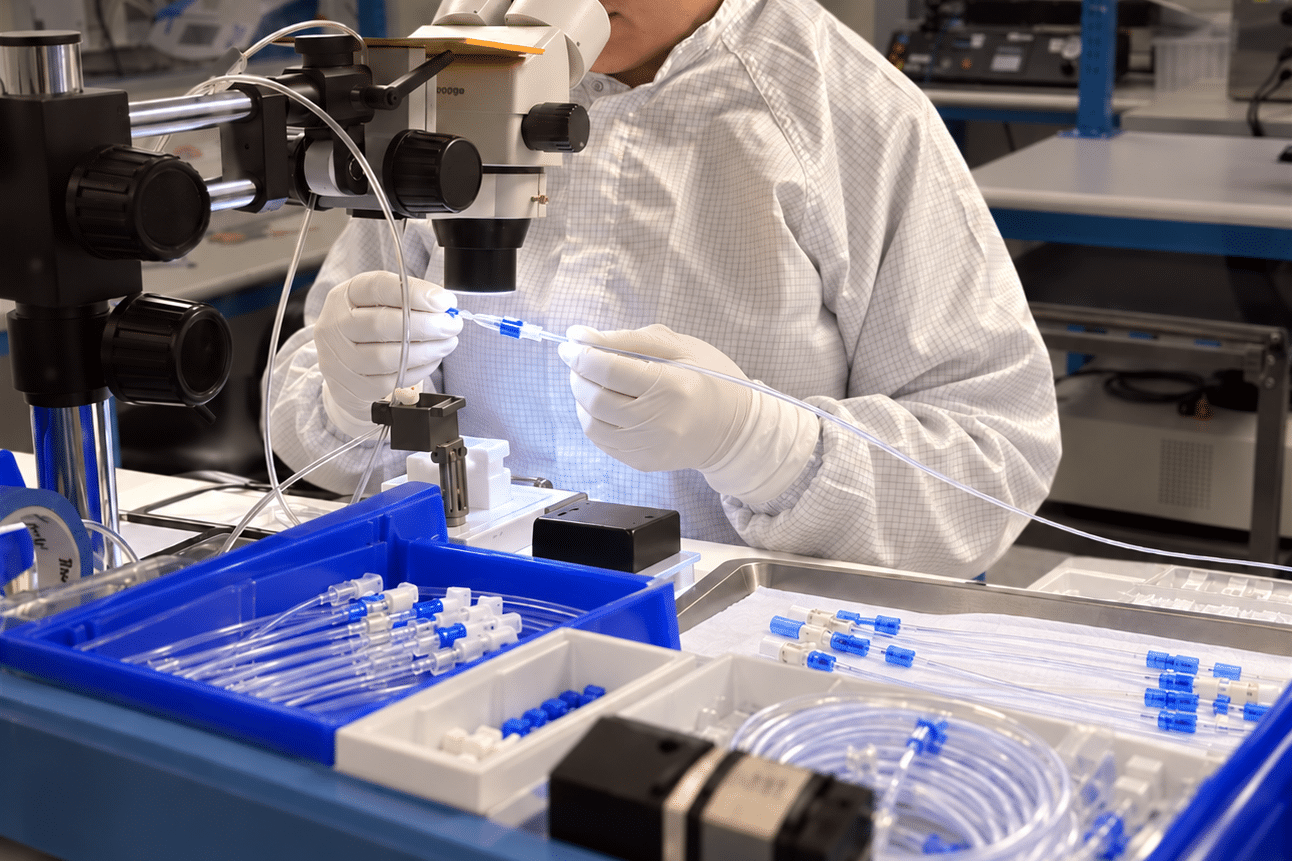
Pathway offers GMP and ISO-controlled cleanroom manufacturing for medical device assembly, pilot builds, validation lots, packaging, and production-readiness activities. Its approach is designed to support both immediate build requirements and eventual transfer to larger-scale production when appropriate.
Understand Capacity, Scalability, and Transfer Strategy
Companies often ask whether a contract manufacturer can produce a particular annual volume. That question matters, but it should be considered alongside development needs, forecast reliability, tooling requirements, labor capacity, equipment availability, and the expected rate of growth.
A manufacturer that is optimized for millions of units may not provide sufficient flexibility during development. Conversely, a development-focused manufacturer may not be intended to remain the final production site once demand reaches a much larger scale.
This is not necessarily a disadvantage. The correct partner is the one aligned with the program’s current risk profile and operational needs.
For many emerging medical device companies, the most effective strategy is to work with a manufacturer that can support engineering builds, verification, validation, clinical production, pilot manufacturing, and early commercialization while developing processes that can later be transferred to a larger facility.
A transfer-ready strategy requires disciplined documentation from the beginning. Fixtures, process parameters, work instructions, inspection methods, equipment requirements, supplier information, validation records, and lessons learned should be captured in a form that another qualified organization can reproduce.
When interviewing manufacturers, discuss not only present capacity but also the expected transition plan. Ask what happens if demand grows faster than anticipated, which operations can be automated, what additional equipment would be required, and how the manufacturer would support a future transfer.
Consider the Value of a San Diego Manufacturing Partner
San Diego offers a dense network of biotechnology, diagnostics, medical device, research, clinical, engineering, and manufacturing organizations. For local medtech companies, proximity to a contract manufacturer can provide practical advantages throughout development and commercialization.
Engineering and manufacturing teams can meet in person to review fixtures, observe assembly processes, investigate failures, approve first articles, and resolve design questions. Physical access is particularly useful during early builds, when drawings and specifications may not capture every aspect of the device.
Local collaboration can also shorten communication cycles. Instead of shipping components across the country for every review or relying exclusively on video calls, teams can visit the manufacturing floor and evaluate issues directly.
The benefit is not simply convenience. Faster technical feedback can reduce the time between identifying a problem and implementing a controlled solution. This becomes especially valuable when the program is approaching a verification build, clinical milestone, submission deadline, or investor commitment.
Local manufacturing may also improve oversight. Device companies remain responsible for evaluating and controlling suppliers, and accessible facilities can make audits, build observations, and periodic business reviews more practical.
San Diego should not be the only criterion, however. A nearby manufacturer is valuable only if it also possesses the appropriate quality system, technical competencies, facilities, documentation practices, and program fit.
References
- FDA: Quality Management System Regulation. Confirms that QMSR became effective on February 2, 2026, incorporates ISO 13485:2016 by reference, and aligns FDA device CGMP expectations with internationally used quality-system requirements.
- FDA: PMA Quality System. Reinforces that design controls include risk analysis, design verification, design validation, design transfer to production specifications, and design-history-file documentation that FDA may review during inspections and premarket review.
- FDA: Overview of Device Regulation. Summarizes the broader commercialization framework, including registration, device listing, premarket pathways, and QMS obligations.
- ISO 13485:2016 official overview. Describes ISO 13485 as the quality management system standard specific to the medical device industry and confirms the standard remains current.
- ISO 14971:2019 official overview. Establishes the risk-management framework that applies across the medical device lifecycle and supports the article’s emphasis on risk-based development and manufacturing decisions.
- ISO 11607-1:2019 official overview. Confirms that sterile barrier systems and packaging systems for terminally sterilized medical devices must maintain sterility until the point of use, supporting the article’s packaging-readiness discussion.
- FDA warning letters on design transfer and design validation failures. These letters show that weak translation into production specifications and validation not based on initial production units remain real enforcement risks, not merely theoretical concerns.