TL;DR
San Diego gives medical device startups something rare: proximity to world-class life sciences research, experienced medtech talent, startup infrastructure, clinical and commercialization resources, and a strong regional manufacturing base.
For founders, that combination can reduce friction between concept, prototype, verification, regulatory strategy, and early production. The advantage is not simply being in a “life sciences city.” It is being in an ecosystem where engineering, regulatory, quality, manufacturing, capital, and clinical insight can come together early enough to influence the path to market.
Why Manufacturing Location Matters More Than Ever
For medical device companies, manufacturing location decisions carry strategic implications that extend far beyond facility costs or tax incentives. Where a device is manufactured directly influences quality systems execution, supplier reliability, workforce availability, regulatory readiness, and the ability to scale production without disrupting compliance.
In today’s medtech environment, manufacturers are operating under increasing pressure to shorten development timelines while simultaneously meeting stricter quality expectations from regulators, providers, and investors. FDA scrutiny around design controls, process validation, supplier management, and post-market quality performance continues to intensify, especially as devices become more software-enabled, connected, and technically complex. As a result, location selection has become a foundational business decision rather than a late-stage operational consideration.
The strongest manufacturing ecosystems in the United States provide more than industrial space. They offer access to experienced medical device engineers, validated suppliers, sterilization partners, testing laboratories, regulatory expertise, and logistics infrastructure that can support commercialization at scale. For startups, the right location can improve access to capital, talent, and manufacturing partners. For established OEMs, it can reduce operational risk, improve production continuity, and strengthen supply chain resilience.
At Pathway MedTech, we frequently help companies evaluate manufacturing readiness, supplier strategy, engineering transfer, and commercialization planning as they transition from development into scalable production. In many cases, manufacturing geography becomes a major determinant of long-term success.
Why San Diego Matters for Medtech Founders
Medical device startups face a different kind of commercialization challenge than many technology companies. A software startup may be able to release, learn, and iterate quickly in the market. A medical device company has to prove much more before reaching patients, clinicians, and customers. The device must be designed for safety and effectiveness, manufactured consistently, supported by documentation, aligned with regulatory expectations, and built within a quality system that can withstand scrutiny.
That is why location still matters in medtech. Even in a remote-work world, device development depends heavily on physical infrastructure, specialized suppliers, engineering talent, regulated manufacturing environments, clinical insight, testing partners, and investors who understand long development cycles. San Diego brings many of these elements into a dense, collaborative ecosystem.
The region is not just a biotechnology hub with a few device companies around it. It is a life sciences market where biotechnology, genomics, diagnostics, medical devices, pharmaceuticals, advanced research, and manufacturing capabilities overlap. San Diego Regional EDC identifies medical devices as one of the key interdisciplinary fields within the region’s life sciences ecosystem, alongside biotechnology, genomics, RNA therapeutics, and pharmaceuticals. It also notes that San Diego’s life sciences companies are developing technologies that include innovative medical devices that improve quality of life.
For startups, that overlap matters. Many modern devices are not purely mechanical or purely electronic. They may involve sensors, biologics, coatings, software, drug delivery, diagnostics, sterile packaging, data systems, or connected care models. A city that supports only one discipline can limit a startup’s ability to solve cross-functional problems. San Diego’s strength is that it gives founders access to an unusually broad set of capabilities in one region.
A Life Sciences Ecosystem With Real Scale
One reason San Diego stands out is the sheer scale of its life sciences sector. Biocom California reported that the San Diego region directly employed 71,448 life science workers and contributed $54.1 billion in total economic output in 2024. That level of density creates a deeper labor pool, more specialized vendors, more experienced advisors, and a stronger base of companies that understand regulated healthcare innovation.
Scale matters because medical device startups often hit problems that require very specific expertise. A founder may need help with design controls, biocompatibility planning, sterilization strategy, clinical workflow, electronics integration, packaging validation, usability, supplier qualification, or manufacturing transfer. In a thinner ecosystem, each of those needs can require a separate search across multiple states or countries. In San Diego, many of those conversations can happen locally, often through networks that already understand medical device commercialization.
CBRE has also described San Diego as a major global life sciences market, supported by universities such as UC San Diego and San Diego State University, along with research institutions including Scripps Research, the Salk Institute, and Sanford Burnham Prebys. CBRE also reported that San Diego life sciences companies secured roughly $19.7 billion in venture capital funding between 2019 and 2024, the third-highest amount globally in its life sciences market analysis.
For medtech founders, this means San Diego is not only a place to start a company. It is a place where a company can mature. The ecosystem supports early discovery, technical development, fundraising, clinical relationships, operational planning, and eventual commercialization. That continuity can be especially valuable for teams trying to avoid the common gap between an exciting prototype and a product that is truly ready for verification, validation, submission, and manufacturing.
Research, Clinical, and Commercialization Infrastructure
Medical device innovation often begins with a clinical need, but it succeeds only when that need is translated into a feasible product, a credible regulatory path, and a viable commercial model. San Diego’s research and commercialization infrastructure helps founders move across those boundaries.
UC San Diego’s MedTech Accelerator, for example, is built around commercialization and offers access to experienced industry mentors, executive advisors, investors, strategic corporate partners, UCSD clinical test facilities, clinical trial design services, and researchers from UCSD and the broader University of California network. For founders coming out of academia, clinical practice, or early concept development, this kind of infrastructure can help turn an idea into a more disciplined development program.
The region also has a strong incubator and shared infrastructure network. Biocom California describes San Diego’s life science incubators as facilities that provide lab infrastructure, expertise, and networks that help startups translate discoveries into real-world impact. Aquillius, for example, offers coworking, office space, wet labs, dry labs, cleanroom access, prototyping tools, and startup support resources in San Diego. EvoNexus also operates a MedTech incubation program in San Diego focused on areas such as AI health device monitoring, remote healthcare, patient monitoring, implanted devices, wearable devices, diagnostic imaging, and decision support.
This kind of startup infrastructure is valuable because early medtech teams often need to conserve capital while still accessing specialized environments and expertise. A startup may not be ready to build its own lab, hire a full regulatory department, or invest in dedicated manufacturing space. Shared infrastructure can help teams move faster while they refine the device, generate data, recruit partners, and prepare for more formal development milestones.
Talent, Capital, and Strategic Partners in One Market
Medical device startups need more than engineers. They need people who understand how devices move through design controls, risk management, usability, supplier selection, process development, quality documentation, regulatory submissions, manufacturing validation, and post-market expectations. That kind of talent tends to concentrate in mature medtech regions.
San Diego’s talent pool benefits from established life sciences companies, research institutions, universities, hospitals, service providers, and suppliers. The practical advantage for a startup is access to people who have seen the full product lifecycle before. That experience matters because many early mistakes are not obvious during concept development. A material choice may appear reasonable during prototyping but later complicate sterilization, biocompatibility, or shelf-life testing. A design may work in the hands of the inventor but fail usability expectations with real users. A supplier may be acceptable for prototype quantities but unsuitable for regulated production.
Investors and strategic partners also play a major role. Medtech funding decisions are heavily shaped by risk. Investors want to understand not only whether the product works, but whether the team can execute through regulatory and manufacturing milestones. In a market with medtech-aware capital, founders are more likely to receive questions that sharpen the development plan rather than simply pressure the team toward speed. The best investors understand that speed without documentation, design discipline, and manufacturing readiness can create expensive delays later.
This is also where experienced development and manufacturing partners become important. Pathway Medtech was founded in 2013 by two mechanical engineers and evolved from a medical device design and engineering firm into an ISO-certified development and manufacturing partner. The company’s public story emphasizes a recurring lesson in medtech: innovation is rarely the only barrier to market. Infrastructure, quality systems, controlled manufacturing environments, documentation discipline, and process validation often determine whether a promising device can move forward.
Manufacturing Readiness Close to the Innovation Core
For medical device startups, one of the most dangerous assumptions is that manufacturing can be solved after the product works. In reality, manufacturing decisions begin influencing the product long before transfer. Materials, tolerances, assembly methods, inspection points, packaging, suppliers, sterilization compatibility, and documentation strategy can all affect the device’s regulatory and commercial future.
This is where San Diego has a distinct advantage. The region gives startups access not only to research and development talent, but also to manufacturing and production-readiness expertise. San Diego Regional EDC notes that the region’s growing manufacturing footprint is strengthened by proximity to Tijuana, which it describes as a world-class medical device manufacturing hub with a highly skilled workforce.
That proximity can matter as companies mature. Early-stage teams may begin with engineering builds, prototype iterations, or low-volume production. As they approach design verification, clinical builds, early commercial production, or transfer to higher-volume manufacturing, they need production systems that are repeatable, traceable, and compliant. A strong regional manufacturing environment can make those transitions more manageable.
Pathway Medtech focuses heavily on this critical transition point. Its production readiness and gap analysis page notes that many early-stage companies can prototype and produce small batches, but the move to higher-volume manufacturing often exposes gaps in documentation, processes, and production infrastructure. Pathway’s role is to help identify and close those gaps before they become costly problems.
The downstream implications are significant. If a startup discovers late that its assembly process depends on undocumented operator judgment, that its suppliers are not qualified, or that its inspection methods are not defined, the company may face redesign, delayed verification, incomplete records, supplier rework, or manufacturing transfer failures. These issues do not just affect operations. They can affect regulatory submission quality, investor confidence, clinical timelines, and launch readiness.
Cleanroom, Packaging, and Early Production Capabilities
Many medical devices require controlled environments, sterile barrier systems, traceability, and build discipline well before they reach full commercial scale. This is especially true for devices moving into design verification, clinical builds, IRB studies, pilot production, or early commercialization. A working prototype is not enough. The device must be built in a way that supports the evidence the company intends to generate.
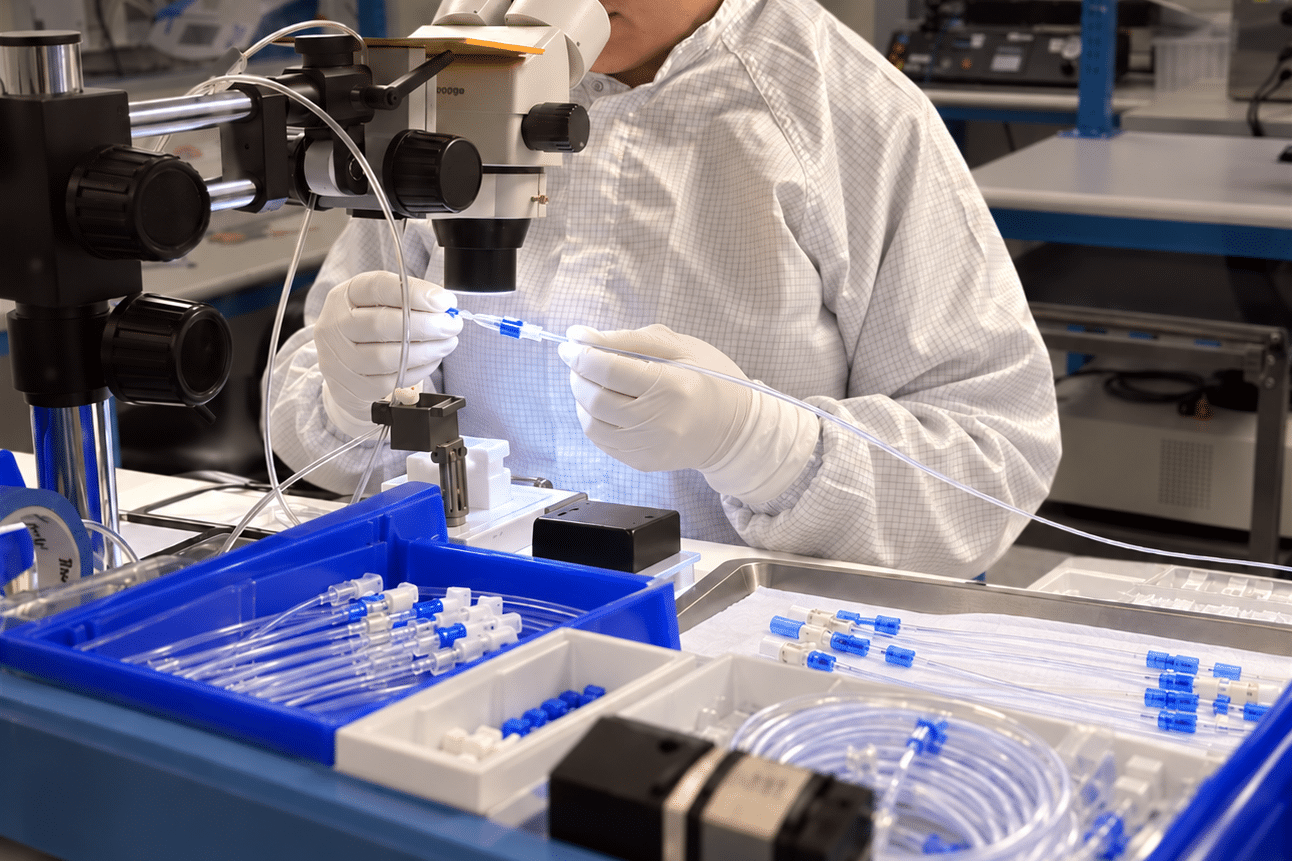
Pathway’s cleanroom manufacturing page makes this distinction clearly: design verification, clinical builds, and early production require more than a working prototype. They require controlled environments, documented processes, and manufacturing discipline that can stand up to regulatory scrutiny. Pathway provides ISO Class 7 cleanroom manufacturing integrated with engineering, quality, and regulatory systems to help teams move from prototype to compliant, scalable production.
Pathway also announced the completion and certification of its fourth ISO Class 7 cleanroom in March 2026, bringing total cleanroom capacity to more than 1,600 square feet and expanding support for early-stage medical device programs moving from prototype into design verification, clinical, IRB, and early commercial manufacturing.
Packaging is another area startups often underestimate. For sterile or terminally sterilized devices, packaging is not a box added at the end. It is part of the device’s safety and regulatory strategy. ISO 11607-1 specifies requirements and test methods for materials, preformed sterile barrier systems, sterile barrier systems, and packaging systems intended to maintain sterility until point of use. Pathway’s packaging services page similarly frames packaging as a core component of device safety and market success because it must maintain sterility, protect functionality, and meet regulatory expectations.
The common mistake is waiting until verification or clinical timelines are already set before building a packaging strategy. That delay can trigger cascading problems: sterilization compatibility concerns, shelf-life study delays, distribution test failures, labeling changes, or submission gaps. Strong medtech ecosystems help founders recognize these issues earlier, and San Diego’s combination of development, cleanroom, packaging, testing, and manufacturing resources makes that earlier alignment more achievable.
Regulatory and Quality Discipline From the Start
San Diego’s ecosystem is valuable, but no ecosystem can substitute for disciplined execution. Medical device startups still have to build within a regulatory and quality framework. In the United States, that framework changed in an important way when FDA’s Quality Management System Regulation became effective on February 2, 2026. FDA states that the QMSR amends the device current good manufacturing practice requirements of 21 CFR Part 820 and incorporates ISO 13485:2016 by reference.
That matters because ISO 13485 is not just a certificate on the wall. ISO describes it as the internationally recognized standard for quality management systems in the design and manufacture of medical devices, helping organizations ensure devices meet customer and regulatory demands for safety and efficacy. For startups, the practical lesson is simple: quality cannot be retrofitted at the end. It has to be built into development, documentation, supplier controls, risk management, production planning, and design transfer.
Risk management is equally central. ISO 14971:2019 provides a framework for identifying hazards, estimating and evaluating risks, controlling those risks, and monitoring the effectiveness of controls throughout the device lifecycle. This connects directly to product decisions. A risk file that is disconnected from design inputs, verification testing, usability work, labeling, manufacturing controls, and post-market planning will not serve the startup well.
Regulatory pathway decisions also shape early development strategy. A device pursuing 510(k), De Novo, or PMA requirements may need different evidence, different testing, different clinical planning, and different timelines. FDA describes De Novo as a risk-based classification process for novel devices without a legally marketed predicate when general controls or general and special controls can provide reasonable assurance of safety and effectiveness. FDA describes PMA as the most stringent type of device marketing application and the process used to evaluate safety and effectiveness for Class III devices.
Pathway’s quality and regulatory page emphasizes that regulatory strategy can make or break the journey to FDA approval, and that intended use is a key starting point as teams move into regulatory strategy. For startups, this is not just a compliance issue. It is a business issue. Misjudging the regulatory path can affect fundraising, product requirements, test plans, clinical strategy, manufacturing readiness, and time to market.
How Pathway Medtech Helps San Diego Device Teams Move Forward
Pathway Medtech fits into the San Diego medtech ecosystem by supporting the stage where many startups need the most practical help: moving from concept, prototype, or early feasibility into controlled development, verification builds, cleanroom manufacturing, packaging, production readiness, and early commercialization.
Pathway’s public materials emphasize an integrated model across development, manufacturing, quality, and regulatory support. Its medical device development page notes that bringing a medical device to market is complex and that decisions from early concept through design, verification, and manufacturing affect cost, timeline, regulatory success, and patient outcomes. Its development and manufacturing page describes support across early design and development, clinical builds, and commercial manufacturing, with a focus on making devices functional, manufacturable, scalable, and regulatory-ready.
For startups, that integration can reduce the number of handoffs between disconnected providers. Instead of treating engineering, quality, regulatory, cleanroom builds, packaging, supply chain, and manufacturing transfer as separate problems, Pathway helps teams connect those decisions earlier. That is especially valuable in San Diego, where founders often have access to excellent scientific and engineering ideas but still need the operational infrastructure to turn those ideas into regulated products.
Pathway is not a replacement for clinical insight, founder vision, investor strategy, or regulatory counsel. It is a practical execution partner for teams that need to build correctly, document clearly, and prepare for the next milestone with fewer surprises.
References
- Biocom California, 2025 Life Science Economic Impact Report.
- San Diego Regional EDC, San Diego Life Sciences Industry Profile.
- CBRE, San Diego Global Life Sciences Market Profile.
- UC San Diego Institute for the Global Entrepreneur, MedTech Accelerator.
- Biocom California, San Diego Life Science Incubators.
- City of San Diego, Life Science Industry Accelerator.
- FDA, Quality Management System Regulation.
- eCFR, 21 CFR Part 820, Quality Management System Regulation.
- FDA, De Novo Classification Request.
- FDA, Premarket Approval.
- ISO, ISO 13485:2016, Medical devices, Quality management systems.
- ISO, ISO 14971:2019, Medical devices, Risk management.
- ISO, ISO 11607-1:2019, Packaging for terminally sterilized medical devices.