TL;DR
Selecting the right manufacturing partner is one of the most critical decisions a medical device executive, founder, or engineering leader will ever make. While traditional commercial pathways force innovators to choose between flexible prototype shops and rigid high-volume factories, Pathway Medtech provides an integrated, single-source alternative. Founded by mechanical engineers, Pathway functions as a “medical device company in a box,” uniting engineering development, ISO 13485 quality management systems, FDA establishment registration, in-house ISO Class 7 cleanroom assembly, and supply chain ecosystem development under one roof. By supporting developing production volumes, managing the broader vendor ecosystem, and maintaining an engineering-connected manufacturing environment, Pathway de-risks regulatory submissions, prevents costly redesigns, and accelerates time to market.
The MedTech Commercialization Dilemma & Conventional Pitfalls
Evaluating key medical device contract manufacturer differentiators is essential for medtech executives, founders, and quality leaders who need to transition a working prototype into controlled commercial production. In the medical device industry, conventional wisdom suggests that companies must navigate a rigid sequence of service providers: hiring an independent engineering firm for design, a regulatory consultant for filings, a prototype shop for early samples, and eventually a massive contract manufacturer (CM) for commercial production.
However, this fragmented approach creates significant operational friction. Early-stage medical device programs frequently experience 6 to 12-month lead time delays, communication gaps, misaligned documentation, and severe budget overruns when transferring complex designs between disconnected vendors. When a design change occurs during prototype assembly, an independent engineering firm must re-issue drawings, an offsite quality consultant must rewrite procedures, and a third-party prototype shop must re-tool. This creates a multi-layered game of phone tag that burns precious runway.
Pathway Medtech was launched in 2013 by experienced mechanical engineers specifically to eliminate this corporate red tape and create a path of least resistance for medical device commercialization. Understanding Pathway’s unique differentiators helps development teams protect timelines, preserve capital, and achieve regulatory success.
Differentiator #1: The “Medical Device Company in a Box”
A primary differentiator of Pathway Medtech is its single-source execution model, often described as a medical device company in a box. Rather than requiring clients to build expensive internal infrastructure or coordinate multiple contractors, Pathway brings cross-functional expertise together under one roof at its facility in Santee (San Diego County), California.
In a traditional fragmented model, an engineering change made during assembly requires an extensive paper trail across multiple companies, taking weeks to resolve while production stands still. At Pathway, engineering, quality assurance, regulatory strategy, and manufacturing operate in continuous alignment within the same facility.
Integrated Capabilities Include:
- Design & Development Engineering: Concept refinement, 3D CAD modeling (SolidWorks), Design for Manufacturability (DFM), Design for Assembly (DFA), rapid prototyping (3D printing/CNC), custom assembly fixture design, and statistical Design of Experiments (DoE).
- Quality & Regulatory Systems: ISO 13485:2016 certified quality management system, FDA registered establishment, FDA Quality Management System Regulation (QMSR) alignment, 21 CFR Part 820 design controls, Device History File (DHF) compilation, and Device Master Record (DMR) establishment.
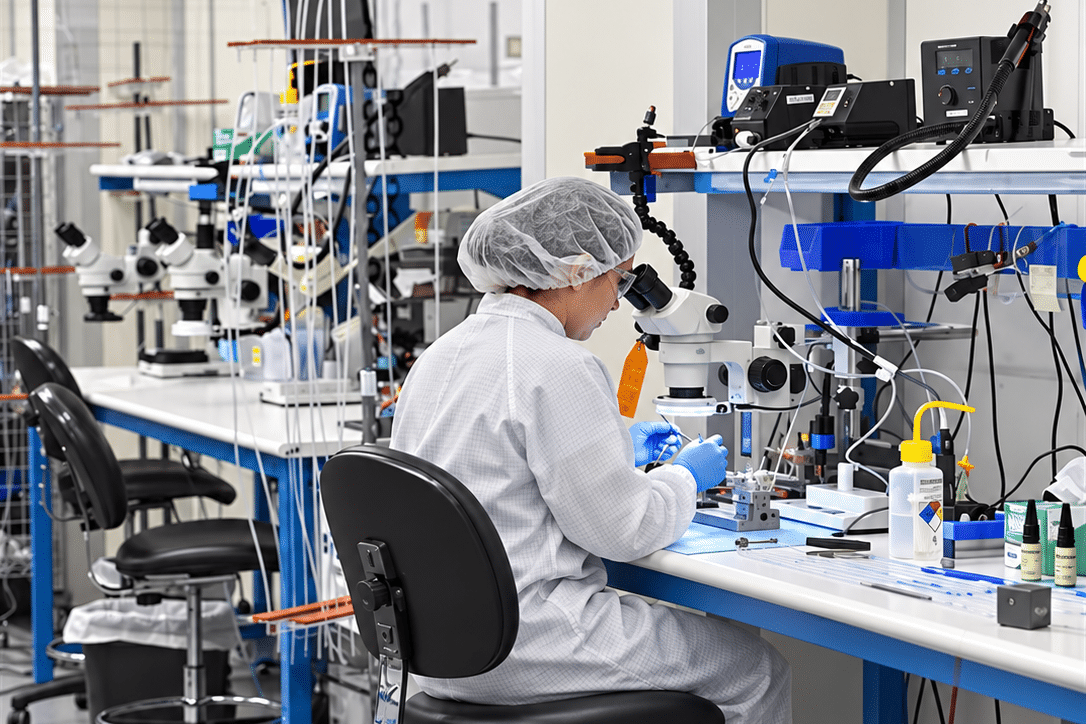
- Controlled Cleanroom Manufacturing: In-house ISO Class 7 and ISO Class 8 cleanrooms, precision sub-assembly, custom fixture usage, primary sterile barrier packaging validation under ISO 11607, impulse pouch sealing, burst testing, and ethylene oxide (EO) sterilization management.
When engineering, quality, and production operate within the same physical environment, design updates do not break manufacturing controls, and quality audits occur seamlessly alongside active production.
Differentiator #2: Bridging the “MedTech Operational Gap”
Traditional Tier-1 contract manufacturers are optimized for mature products, locked designs, automated assembly lines, and predictable high-volume forecasts. Consequently, when an early-stage or growth-stage company needs 50 to 1,000 units for Device Verification (DV) builds, clinical trial lots, or pilot commercial launches, large CMs often reject the program or enforce prohibitive Minimum Order Quantities (MOQs) and high overhead fees.
Conversely, R&D prototype shops lack the certified ISO 13485 quality systems, Device Master Records (DMR), and cleanroom environmental controls required for formal regulatory submissions to the FDA. This structural mismatch creates the MedTech Operational Gap. Pathway Medtech occupies this exact whitespace by specializing in developing production volumes. Pathway delivers the regulatory rigor of a major contract manufacturer combined with the agility and responsiveness needed while device designs and manufacturing processes are still maturing.
Comparative Industry Matrix: Prototype Shops vs. Pathway vs. Tier-1 CMs
| Feature / Capability | R&D Prototype Shops | Pathway Medtech | Tier-1 Contract Manufacturers |
|---|---|---|---|
| Target Production Volume | 1 – 10 units (Feasibility) | 50 – 1,000+ units (Developing) | 10,000+ units (Automated) |
| ISO 13485 & FDA Controls | Non-compliant / Unregistered | Fully Certified & FDA Registered | Fully Certified & FDA Registered |
| Cleanroom Infrastructure | None / Standard Lab Bench | In-House ISO Class 7 & 8 Cleanrooms | Large Automated Cleanroom Bay |
| Engineering Flexibility | High (Uncontrolled changes) | High (Regulated ECO execution) | Low (Locked designs, rigid contracts) |
| Minimum Order Quantities | None | Flexible / Right-Sized | High MOQs ($100k+ commitments) |
Differentiator #3: Engineering-Led Operations vs. “Build-to-Print” Inflexibility
Many traditional contract manufacturers operate on a strict “build-to-print” philosophy. If an engineering drawing contains an unworkable tolerance stack-up or an inefficient assembly sequence, traditional CMs may simply build the non-conforming part or issue slow, costly Engineering Change Orders (ECOs) that stall momentum.
Because Pathway Medtech was founded by hands-on mechanical engineers (Co-Founders Arthur Deptala and Jonas Cochran), engineering and shop-floor manufacturing remain tightly connected. Pathway’s technical team approaches every program through the lens of Design for Manufacturability and assembly optimization. If an assembly fixture requires refinement or a component supplier requires qualification, Pathway’s engineers resolve the issue on the floor in real time. This engineering-connected model converts complex “lab heroics” into standardized, repeatable assembly procedures.
Differentiator #4: Building and Managing the “Product Ecosystem”
A commercial medical device requires far more than cleanroom floor space. It depends on a qualified network of specialized resin suppliers, component fabricators, biocompatibility testing laboratories, primary packaging converters, and sterilization facilities. Managing this multi-tiered supply chain independently often overwhelms internal operations teams.
Pathway Medtech extends its service model beyond internal facility walls by building and managing a custom product ecosystem for each client. Pathway identifies, audits, qualifies, and orchestrates specialized external vendors under Pathway’s audited Quality Management System. By serving as the single point of accountability for supply chain development, material procurement, and sterilization coordination, Pathway removes vendor management overhead from client teams.
Differentiator #5: A Strategic “Bridge to Scale”
Pathway Medtech recognizes that a medical device program’s manufacturing destination may evolve over time. While some clients maintain commercial production at Pathway indefinitely, others eventually reach production volumes that warrant transitioning to a massive, high-volume Tier-1 contract manufacturer.
Pathway embraces this transition through its Bridge to Scale framework. Pathway stabilizes the early manufacturing process, completes process validation (IQ/OQ/PQ), establishes a complete Device Master Record, and packages a clean manufacturing transfer bundle. When a product is ready for high-volume automation, Pathway facilitates a seamless handoff to the client’s chosen high-volume CM (such as Viant, Harmac, or PiSA), ensuring that process knowledge and regulatory compliance remain intact.
Proven Execution: Real-World Client Case Studies
Pathway’s differential approach is validated across a wide spectrum of complex medical technologies and surgical disciplines:
- GuideStar Medical Devices (Epidural Positioning System): GuideStar partnered with Pathway to transition an innovative epidural needle positioning device from early concept through FDA 510(k) clearance. Pathway performed full DFM, established the Device History File (DHF) and Device Master Record (DMR), built verification units in an ISO Class 7 cleanroom, and managed sterile packaging validation. GuideStar successfully received FDA clearance and launched commercial production under Pathway’s quality controls.
- Neurgain Technologies (Intraspinal Drug Delivery Platform): Neurgain required high-precision mechanical assembly and custom fixture development for a novel neural drug delivery platform and magnetic needle positioning system. Pathway engineered precision assembly fixtures, established component inspection criteria, and executed cleanroom builds to support clinical studies.
- Sylke Wound Care (Silk-Based Closure Device): Sylke developed a proprietary silk-derived wound closure system requiring novel material handling, precise tensioning, and sterile barrier pouch sealing. Pathway built a customized multi-step supply chain, qualified specialized material suppliers, and established validatable cleanroom packaging workflows.
- LivsMed Inc. (Laparoscopic Surgical Instrument Distribution & R&D): LivsMed leveraged Pathway as its U.S. operational hub for multi-articulating laparoscopic surgical instruments. Pathway provided receiving quality inspection, custom modifications, Device History Record tracking, and U.S. logistics fulfillment.
❓ Frequently Asked Questions (FAQs)
What size production volumes does Pathway Medtech support? Pathway specializes in developing production volumes, ranging from short-run prototype lots of 10 to 50 units for early feasibility testing, up to 50 to 1,000+ units per month for Device Verification builds, clinical trial supplies, and pilot commercial distribution.
Does working with Pathway mean we are locked into a single contract manufacturer forever? No. Pathway operates as a “Bridge to Scale.” We establish complete, audit-ready Device Master Records and validated processes. If your product reaches commercial volumes that require high-speed automation, we provide a clean, documented transfer package to hand off to a Tier-1 high-volume contract manufacturer.
How does Pathway handle Intellectual Property (IP) retention? All intellectual property created during engineering development, custom tooling design, fixture design, and process optimization remains 100% owned by the client. Pathway operates as an execution partner to build long-term enterprise value for your organization.
What cleanroom classifications are available in-house at Pathway? Pathway maintains controlled assembly environments, including in-house ISO Class 7 and ISO Class 8 cleanrooms at our FDA-registered facility in Santee (San Diego County), California.
How does Pathway differ from an independent R&D engineering firm? While engineering firms deliver drawings and CAD models, they do not own an FDA-registered manufacturing facility or an ISO 13485 quality system. Pathway integrates engineering with cleanroom assembly, ensuring that every design decision is grounded in real-world manufacturability and regulatory compliance.
Can Pathway manage sterilization and biocompatibility testing? Yes. As part of our product ecosystem management service, Pathway selects, qualifies, and orchestrates certified third-party testing CROs and Ethylene Oxide (EO) sterilization providers under Pathway’s audited QMS.
What is the Production Readiness & Gap Analysis Audit? The Production Readiness Audit is a fixed-scope engagement where Pathway engineers evaluate your existing drawings, work instructions, bills of materials (BOM), and assembly fixtures to identify technical, quality, and supply chain gaps before initiating formal verification builds.
How quickly can a new client onboard with Pathway? Because Pathway maintains an active ISO 13485 quality system and cloud-based QMS infrastructure, client onboarding can begin immediately following mutual non-disclosure execution and initial project scoping.
Regulatory & Industry References
- U.S. Food and Drug Administration (FDA): Title 21 CFR Part 820, Quality System Regulation & Quality Management System Regulation (QMSR). Available at: https://www.ecfr.gov/current/title-21/part-820
- International Organization for Standardization (ISO): ISO 13485:2016, Medical devices: Quality management systems, Requirements for regulatory purposes. Available at: https://www.iso.org/standard/59752.html
- International Organization for Standardization (ISO): ISO 14971:2019, Medical devices: Application of risk management to medical devices. Available at: https://www.iso.org/standard/72704.html
- International Organization for Standardization (ISO): ISO 11607-1:2019, Packaging for terminally sterilized medical devices. Available at: https://www.iso.org/standard/67078.html