TL;DR
Medical device packaging is not simply the final step between manufacturing and shipment. For sterile devices, the package is an engineered system that must protect the product, support the selected sterilization modality, maintain sterile barrier integrity, and withstand expected distribution and storage conditions.
Pathway MedTech supports sterile barrier system development, pouch and tray sealing, packaging process validation, packaging integrity testing, accelerated and real-time aging, sterilization coordination, labeling support, cleanroom packaging, and low-to-mid-volume production. The goal is to connect packaging decisions to the broader medical device development and commercialization strategy, helping teams reduce validation gaps, unnecessary redesign, and late-stage program delays.
Where Packaging Becomes Part of Product Strategy
For many medical device programs, packaging receives serious attention later than it should. Engineering teams may spend months refining device geometry, materials, usability, performance, manufacturing processes, and supply chains. As Design Verification, sterilization validation, clinical builds, or commercialization approach, packaging suddenly becomes a critical workstream.
That timing can create problems because medical device packaging is connected to many downstream milestones. For a terminally sterilized device, the sterile barrier system must be compatible with the selected sterilization process. Its materials and seals need to tolerate handling and transportation, while the overall package must continue protecting critical device features throughout the intended shelf life.
The packaging process itself must also be controlled. Where validation is required, the process needs to demonstrate that acceptable packages can be produced repeatedly under defined manufacturing conditions. A package that works during a handful of engineering builds is not necessarily a package that is ready for validated production.
FDA’s current Quality Management System Regulation, or QMSR, became effective on February 2, 2026 and incorporates ISO 13485:2016 into 21 CFR Part 820. This reinforces an important principle for manufacturers: packaging should be considered part of the controlled product and manufacturing strategy rather than a purchasing decision made after development is nearly complete.
This is where Pathway MedTech’s model can be particularly useful. Packaging support can be connected with engineering, quality, regulatory planning, cleanroom manufacturing, validation, sterilization coordination, and early production. Pathway supports programs ranging from engineering and verification builds through clinical and commercial production, allowing packaging requirements to mature alongside the device instead of becoming a separate downstream project.
Start With the Sterile Barrier System
The sterile barrier system, commonly abbreviated SBS, is the minimum packaging configuration needed to maintain sterility until the point of use for a terminally sterilized medical device. Depending on the application, the system may use a flexible pouch, a thermoformed tray with a lid, or another suitable material configuration. The package should be designed around the device, the sterilization method, and the conditions the product is expected to encounter throughout its lifecycle.
The right solution is not simply whichever pouch or tray is readily available. Device geometry matters. Sharp or concentrated features can create abrasion or puncture risks, while heavier components may load a tray differently during transportation than they do while sitting on a workbench. Flexible products can shift during distribution, and delicate components may require backer cards or other protective features to control movement and reduce stress on the sterile barrier.
Packaging materials must also tolerate the selected sterilization process. A material or seal that performs well before sterilization may behave differently afterward, which is why sterilization compatibility should be considered during packaging development rather than after the package has already been selected.
Pathway supports sterile barrier system development using pouch materials such as Tyvek®, medical paper, foils, and laminates. Capabilities also include thermoform tray design and seal development, backer-card prototyping, packaging design analysis, and evaluation of compatibility with EO, gamma, and e-beam sterilization.
These decisions matter because a package can appear acceptable during an early engineering build and still become a validation problem later. Material changes after sterilization can affect performance. An unnecessarily narrow sealing surface can reduce process margin, while movement inside a tray can create abrasion or damage. Poor opening characteristics can also create usability or presentation concerns at the point of use.
ISO 11607-1 addresses requirements for materials, sterile barrier systems, and packaging systems for terminally sterilized medical devices. Its scope reflects the broader principle behind packaging development: the package must function as a system capable of maintaining the required sterile barrier through the intended lifecycle of the product.
Pathway can help teams evaluate package format, sealing approaches, protective configurations, sterilization compatibility, and validation requirements before those decisions become costly downstream changes.
Design Around Sterilization, Distribution, and Shelf Life
A medical device package does not experience only one environment. It experiences an entire lifecycle. The product may be assembled and packaged in a controlled manufacturing environment, transported to a sterilization provider, exposed to a validated sterilization process, returned to inventory, shipped through distribution networks, stored for an extended period, and eventually opened by healthcare personnel.
A strong packaging strategy considers these conditions together. One common mistake is selecting packaging materials before the sterilization strategy has stabilized. Another is beginning validation before the final device geometry, protective components, labeling configuration, or shipping arrangement has been established. Either approach can generate data that no longer represents the eventual commercial configuration.
FDA guidance for sterile 510(k) submissions addresses the need to describe the sterile barrier system and how it will maintain sterility. FDA also addresses packaging test methods and simulated distribution. The practical implication is that sterilization, distribution simulation, environmental conditioning, and shelf-life planning should not be treated as unrelated validation exercises.
The validation plan should clearly establish which configuration is being evaluated, which conditions the package must survive, and why the resulting data are representative of the marketed product. That connection becomes especially important when teams are working against regulatory or commercialization timelines and cannot afford to repeat testing because the configuration changed midway through the program.
Pathway supports material compatibility evaluation for EO, gamma, and e-beam sterilization. Pathway can also support sterilization coordination, distribution simulation coordination, post-sterilization packaging evaluation, accelerated and real-time aging, and sterile barrier integrity testing.
The sequencing of these activities should reflect the device, its risks, and its intended lifecycle. The resulting evidence should tell a coherent story in which sterilization, distribution, aging, and package integrity all support the same packaging strategy.
Process Validation Turns Sealing Into Manufacturing
Creating a successful seal once is development. Demonstrating that a packaging process can repeatedly produce acceptable seals under defined manufacturing conditions is a different challenge. ISO 11607-2 addresses validation requirements for forming, sealing, and assembly processes used for terminally sterilized medical device packaging.
For heat-sealed packaging, several variables can influence the finished seal. These may include time, temperature, pressure, tooling, equipment configuration, and packaging materials. A nominal setting may produce an attractive package during development, but a validated process requires a defensible operating window that can accommodate expected manufacturing variation.
This is where Installation Qualification, Operational Qualification, and Performance Qualification become important. IQ establishes that relevant equipment and setup are installed and configured appropriately. OQ evaluates the process across defined parameter ranges and can help establish acceptable process limits. PQ then demonstrates performance under representative production conditions.
Depending on the process and validation strategy, PQ may include repeated runs, normal production variability, material variability, and process capability analysis. These activities help move the process away from reliance on a single successful setup and toward documented evidence that the operation can consistently produce acceptable output.
Pathway develops and executes packaging IQ, OQ, and PQ activities, including worst-case seal parameter validation and process capability studies. Pathway’s packaging capabilities also include establishing and evaluating critical sealing parameters such as time, temperature, and pressure.
A frequent mistake is treating validation as documentation of settings that happened to work during one successful build. Another is establishing an operating window that is so narrow that normal manufacturing variation continually pushes the process toward its limits. Both can contribute to nonconforming product, excessive inspection, unnecessary rework, or pressure to modify a validated process after production has already begun.
Good packaging process development should therefore answer a larger question than whether a seal can be made. The process should be capable of producing that seal consistently, inspecting it appropriately, documenting it effectively, and maintaining control as manufacturing evolves.
Packaging Testing Should Answer Risk Questions
Packaging validation is strongest when the test program addresses specific failure modes rather than functioning as a generic checklist. Seal strength testing can help characterize the strength and consistency of flexible barrier seals, while dye penetration testing can help identify channels or defects in applicable porous medical packaging configurations. Burst or pressure-based testing can provide additional information about package integrity and seal performance.
Distribution simulation evaluates whether the packaged device can tolerate expected transportation stresses. Aging studies add another dimension by examining whether package performance remains acceptable after simulated or actual storage. When these methods are selected thoughtfully, they help build evidence around the risks that are most relevant to the device and its intended packaging configuration.
Pathway’s published capabilities include seal strength testing using ASTM F88, dye penetration using ASTM F1929, and burst or pressure testing using ASTM F1140 and F2054. Pathway also supports accelerated aging using ASTM F1980, real-time aging, distribution simulation coordination, and post-sterilization performance testing.
The purpose is not simply to generate more test reports. A well-designed program should answer meaningful questions about risk. Will seals remain acceptable after sterilization? Could product movement during transportation create abrasion or puncture? Does aging affect seal performance? Does the finished configuration protect the device itself?
Another common mistake is testing an idealized sample instead of a representative finished configuration. A flat, empty pouch can behave differently from a pouch containing the final device, backer card, label, and protective components. Testing before sterilization or aging may also fail to answer the questions that matter for the finished commercial package.
Pathway can help connect test selection, sample generation, conditioning, sterile barrier testing, and documentation. The objective is to build a validation package that supports the broader device development and commercialization strategy rather than a collection of disconnected laboratory reports.
Shelf Life Is More Than Aging Samples
Shelf life is often discussed primarily in terms of accelerated aging, but the actual question is broader. Will the device and its packaging continue to perform as intended throughout the labeled storage period? For a sterile medical device, that question may involve material stability, device functionality, sterile barrier integrity, seal performance, labeling, adhesives, and protective packaging.
Shelf-life planning is therefore both a product activity and a packaging activity. Accelerated aging allows teams to simulate longer storage periods by exposing products to elevated temperatures under controlled conditions. Real-time aging follows the product through the actual claimed storage period and provides longer-term confirmation of performance.
The aged samples must then be evaluated against the requirements established for the device and packaging system. Simply placing samples in a chamber does not establish shelf life. The value comes from having a defined protocol, representative samples, controlled conditions, appropriate post-aging testing, and documentation that supports the intended claim.
Pathway supports accelerated and real-time aging programs using controlled environmental chambers. Capabilities include protocol development, temperature monitoring, environmental data collection, study management, sample generation, sterile barrier testing, seal-strength evaluation, leak testing, and reporting.
The downstream planning matters. If a company waits until regulatory submission is approaching before designing the shelf-life program, the calendar can quickly become difficult to manage. A change to pouch material, tray design, sterilization process, sealing parameters, or device configuration may also affect the relevance of previously generated aging data.
Integrating shelf-life planning with packaging development helps teams establish representative configurations sooner. It can also reduce the likelihood that an avoidable packaging change disrupts the validation timeline.
Labeling and Traceability Are Packaging Controls
Packaging performance is not limited to the physical sterile barrier. Labels need to carry the appropriate information, remain associated with the correct device, and support traceability through manufacturing and distribution. For many devices marketed in the United States, the Unique Device Identification framework also adds requirements that need to be considered as part of the finished packaging configuration.
FDA’s UDI system generally requires device labelers to place a UDI on device labels and packages unless an exception or alternative applies. The UDI is typically provided in easily readable plain text and an automatic identification and data capture format. This makes labeling a manufacturing and packaging consideration, not simply a graphics exercise.
Label size and placement can affect packaging design, while expiration dating and lot information must correspond with controlled records. Barcodes need to remain readable, and label materials may experience sterilization, handling, temperature changes, and prolonged storage. These factors become more important as the product moves from development builds toward commercial configuration.
Pathway’s published packaging services include UDI implementation and verification, support for FDA 21 CFR Part 801 labeling requirements, and barcode durability and scannability testing. Pathway can also integrate labeling considerations into the broader packaging validation strategy.
One common problem is allowing labels to develop on a separate timeline from packaging and manufacturing. Late changes to artwork, barcode layout, package size, lot-control strategy, or expiration dating can force teams to revisit packaging specifications and validation documentation. Treating labeling as part of the packaging system creates stronger alignment between the physical product, traceability requirements, regulatory information, and manufacturing controls.
Low-Volume Packaging Still Requires High Discipline
Early-stage medical device packaging has an unusual economic profile. Volumes may be small, but the importance of each unit can be extremely high. A Design Verification build may contain only the units required for a defined protocol, while a clinical or IRB build may involve modest quantities that are directly connected to a significant development milestone.
A pilot commercial run may also be small, yet it can represent the first opportunity to exercise the complete manufacturing, packaging, sterilization, release, and distribution workflow. Small volume does not mean unimportant volume. In many cases, these early lots carry more program risk per unit than mature commercial production.
This can create challenges when emerging medtech companies work with manufacturing organizations optimized primarily for large recurring orders. Engineering builds, DV lots, clinical runs, and early commercial quantities may not fit efficiently into production models designed around mature, high-volume programs.
Pathway’s low-volume packaging model is designed for engineering runs, DV and clinical builds, and early commercial production. Capabilities include packaging design and development, pouch and tray seal validation, sourcing and supply-chain development, packaging validation, stability testing, and sterilization coordination.
Pathway also operates within an ISO 13485-certified and FDA-registered quality environment. That matters because development-stage products continue to evolve. Tooling may still be changing, suppliers may still be stabilizing, and labeling may be moving toward its final commercial configuration. Sealing processes may also be transitioning from engineering settings into validated operating windows.
The objective should not be to postpone manufacturing discipline until volumes increase. The better approach is to introduce the appropriate level of control early enough that the program can learn, validate, and scale without creating an entirely new commercialization effort later.
Packaging Works Better When Manufacturing Is Connected
A packaging provider can seal a pouch. A medical device commercialization partner needs to understand what happens before and after that seal. For a development-stage program, packaging may intersect with cleanroom assembly, inspection, labeling, sterilization coordination, aging, validation samples, finished-goods release, and production transfer.
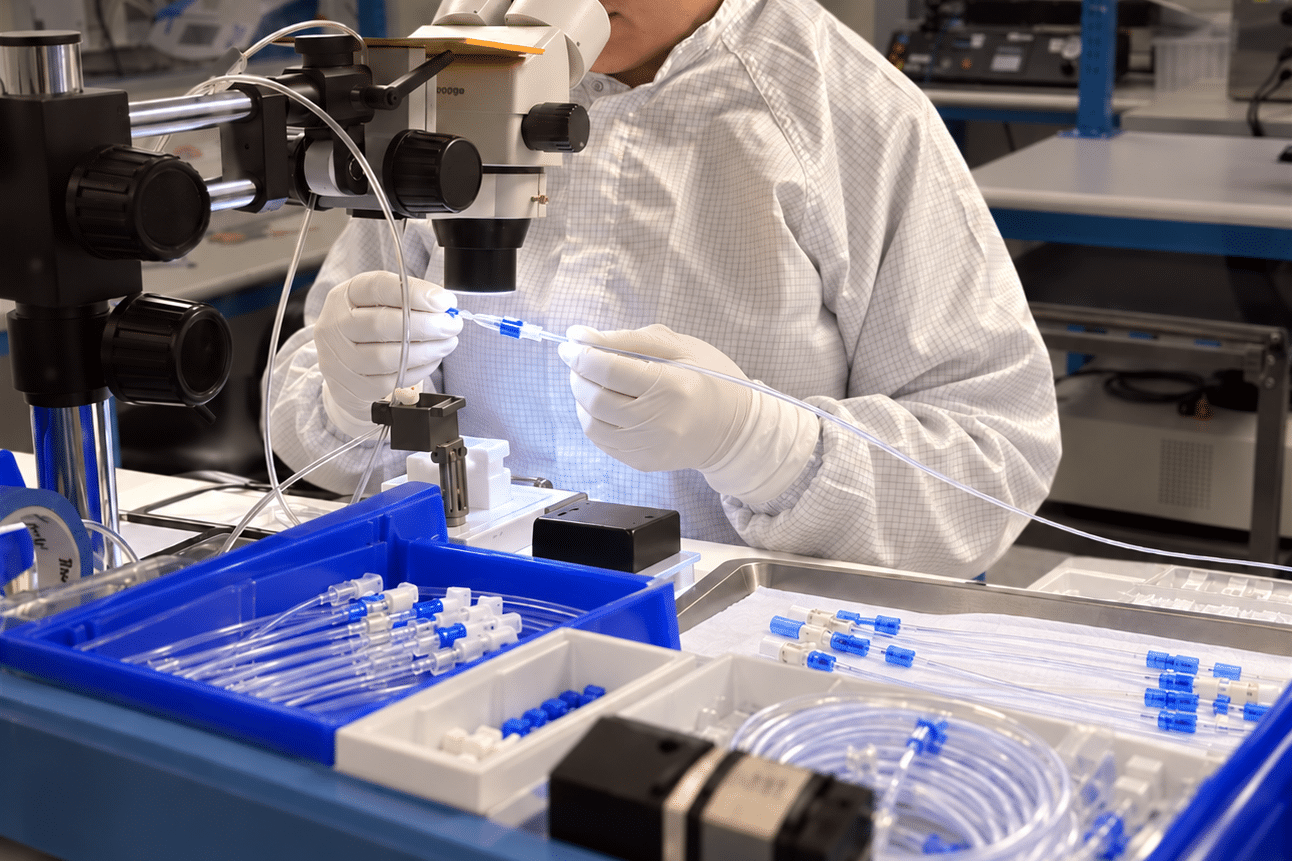
Pathway operates ISO Class 7 cleanroom manufacturing environments that support controlled builds, Design Verification builds, pilot builds, inspection activities, and low-to-mid-volume production. Pathway also supports sterile barrier packaging, including tray sealing, while its broader manufacturing capabilities include sterilization coordination, stability testing, process validation support, traceability, and production-transfer readiness.
A connected structure can reduce unnecessary handoffs between engineering, manufacturing, packaging, quality, and validation teams. More importantly, it can expose problems earlier. A difficult-to-package device feature can be discussed with engineering, while a sealing issue can be evaluated in the context of materials and process parameters. Shelf-life requirements can also be considered while the packaging configuration is still being developed.
Pathway’s published epidural-device case study illustrates this lifecycle approach. The engagement began with packaging strategy and early Design Verification and validation support, then expanded into regulatory and manufacturing work. Following clearance, Pathway supported assembly, finished-goods packaging, sterilization coordination, and distribution for early commercial production.
The value of integration does not mean that every medical device company must use a single vendor. The value is continuity. Reducing disconnected assumptions between development, validation, packaging, and manufacturing can make the transition from prototype to regulated production more manageable.
Build Packaging Evidence Before the Deadline
The strongest medical device packaging strategies are not necessarily the most complicated. They are the strategies in which the package, process, testing, sterilization approach, shelf-life plan, labeling, and manufacturing records all support the same product configuration.
The sterile barrier system should protect the product and support its intended sterilization process. The packaging process should operate within a justified and repeatable window, while validation testing should address the risks that matter to the finished device. Aging studies should support the intended shelf-life claim, and distribution testing should represent the transportation and handling conditions the product is expected to encounter.
Labeling and traceability should remain connected to the controlled manufacturing configuration as well. When these activities are planned independently, packaging can become a source of late-stage surprises. When they are developed as part of a coordinated manufacturing and commercialization strategy, packaging becomes objective evidence that the product can move from controlled production to the point of use while maintaining the requirements that matter.
That is the role Pathway MedTech is positioned to support. Pathway works with medical device teams on sterile barrier development, packaging validation, cleanroom packaging, low-volume builds, shelf-life studies, sterilization coordination, and early commercial manufacturing.
Packaging should not be the task that begins after the device is finished. It should be part of the pathway that gets the device finished.
References
- FDA, Quality Management System Regulation (QMSR). Current FDA information on the QMSR, which became effective February 2, 2026 and incorporates ISO 13485:2016 into 21 CFR Part 820.
- FDA Recognized Consensus Standards, ISO 11607-1:2019 including Amendment 1:2023. Requirements for materials, sterile barrier systems, and packaging systems for terminally sterilized medical devices.
- FDA Recognized Consensus Standards, ISO 11607-2:2019 including Amendment 1:2023. Validation requirements for forming, sealing, and assembly processes.
- FDA, Submission and Review of Sterility Information in Premarket Notification 510(k) Submissions for Devices Labeled as Sterile. FDA guidance covering sterilization information, sterile barrier descriptions, and packaging test methods for applicable 510(k) submissions.
- FDA, UDI Basics. FDA overview of Unique Device Identification requirements for device labels and packages.
- FDA Recognized Consensus Standards, ISO 14971:2019. FDA-recognized standard for applying risk management to medical devices.