TL;DR
Being turned away by a large medical device contract manufacturer does not necessarily mean your device is unmanufacturable or commercially unattractive. More often, it means your program has reached a stage that does not fit the manufacturer’s operating model.
Large contract manufacturers are generally built to perform efficiently when designs are stable, processes are established, suppliers are qualified, documentation is controlled, and production forecasts justify dedicated resources. Early-stage medical device companies often need something very different. They may need 50, 200, or 1,000 units for design verification, clinical use, validation, pilot production, or an early market launch while engineering and manufacturing processes are still maturing.
That creates a critical gap between prototype development and scaled commercial manufacturing. The solution is not necessarily to keep searching for another large CM willing to accept the same program. The better approach is often to work with a development-stage manufacturing partner that can help mature the design, process, supply chain, documentation, and quality infrastructure until the program is genuinely ready to scale.
Pathway MedTech supports this transition through integrated engineering, quality and regulatory support, supply chain development, controlled manufacturing, ISO Class 7 cleanroom capabilities, packaging support, verification builds, and production-transfer readiness.
A Working Device Is Not Yet a Manufacturing Program
Reaching a functional prototype is a major milestone. It proves that the engineering concept can work.
It does not necessarily prove that the device can be manufactured repeatedly, inspected consistently, documented appropriately, sourced reliably, packaged correctly, or produced at an economically sustainable cost.
That distinction becomes important when an early-stage company approaches a major contract manufacturer.
The development team may be thinking:
“We need 300 devices.”
The manufacturer is evaluating a much broader question:
“Can this program be transferred into our manufacturing system efficiently, repeatedly, and at a scale that makes sense for our operation?”
Large medical device contract manufacturers typically operate complex facilities with specialized production equipment, quality systems, supply chain teams, manufacturing engineers, program managers, validation resources, and significant fixed overhead. Their economics improve when those resources can support repeatable production over meaningful volumes.
An early-stage program can create the opposite situation.
The build may require engineering interpretation. Drawings may still change. Fixtures may need development. Suppliers may not be fully qualified. Assembly instructions may still depend on tribal knowledge. Inspection criteria may need refinement. The first production run may uncover changes that affect the second.
For the device company, those activities are necessary steps toward commercialization. For a manufacturer structured primarily around mature production, they can represent a significant amount of work before meaningful production even begins.
This is why a manufacturing rejection should not automatically be interpreted as a negative judgment about the technology.
It may simply mean the device is asking the manufacturer to solve a development problem when its infrastructure is optimized to solve a production problem.
The MedTech Operational Gap
There is a period in medical device commercialization where a company can find itself caught between two very different worlds.
The device has moved beyond basic prototyping, but it is not yet ready for conventional high-volume manufacturing.
We can think of this as the MedTech Operational Gap.
At this point, a team may have a functional design and promising test results, but important elements of the eventual manufacturing system are still developing. The bill of materials may need refinement. Component suppliers may need qualification. Assembly processes may need formal work instructions. Fixtures and inspection methods may still be evolving. Packaging and sterilization strategies may not be finalized. Manufacturing tolerances that worked for hand-built prototypes may need to be reconsidered for repeatable production.
Yet the company may already need real devices.
Those units could be needed for design verification, design validation, clinical activities, packaging studies, sterilization work, investor demonstrations, limited market introductions, or early commercial demand.
This is precisely where the distinction between prototype fabrication and regulated manufacturing becomes important.
The manufacturing process begins creating more than devices. It begins creating evidence.
As programs move toward evidence-generating builds and commercial production, the systems surrounding the product become increasingly important. FDA’s Quality Management System Regulation, which became effective February 2, 2026, incorporates ISO 13485:2016 by reference as the foundation of the quality management system requirements applicable to covered medical device manufacturers. ISO 13485 establishes a framework intended to support consistent design, development, production, and delivery of medical devices.
That does not mean every proof-of-concept prototype needs to be produced inside an ISO 13485-certified facility. It does mean there comes a point where informal manufacturing methods stop being sufficient for what the program needs to prove next.
Recognizing that point early can prevent a company from trying to jump directly from prototype into an operating model designed for mature commercial production.
Why Large Contract Manufacturers Say No
A contract manufacturer may decline an early-stage medical device for several reasons. Importantly, those reasons are often connected.
The design is still evolving
Large-scale manufacturing becomes substantially easier when the product configuration is stable.
An early-stage company may still be changing materials, tolerances, component geometry, adhesives, assembly methods, packaging, labeling, firmware, or suppliers. Those changes may be entirely appropriate during development, but each one can trigger downstream work for a manufacturer.
A seemingly minor component change can affect purchasing, inventory, drawings, inspection requirements, work instructions, fixtures, risk documentation, process validation, packaging, or testing.
A manufacturer optimized around repeatable production wants those variables controlled. An early-stage company may still need the flexibility to change them.
The production volume does not support the infrastructure
There is no universal medical device contract manufacturer minimum order quantity.
Different manufacturers evaluate programs differently. Some consider annualized revenue, others forecasted units, production hours, facility utilization, strategic fit, equipment requirements, or expected long-term growth.
The underlying issue is usually the same: setup costs do not disappear simply because the order is small.
A 200-unit medical device program can still require engineering review, quoting, sourcing, incoming inspection, production documentation, operator training, fixture development, quality oversight, purchasing, inventory management, line setup, testing, packaging, and final release.
When those activities are spread across hundreds of units instead of tens or hundreds of thousands, the economics can become difficult for a large production organization.
The manufacturing package is incomplete
One of the most common misconceptions in early-stage medtech is that CAD files, drawings, and a bill of materials constitute a manufacturing transfer package.
They are important, but they are only part of it.
A production-ready system may also need controlled assembly procedures, inspection requirements, approved suppliers, material specifications, fixtures, test methods, acceptance criteria, packaging specifications, labeling information, traceability requirements, quality controls, and clearly defined revision status.
Pathway’s manufacturing transfer guidance emphasizes the same distinction: transfer is not simply moving documentation from one organization to another. It is demonstrating that design intent can be executed through controlled processes, people, equipment, suppliers, and records.
When critical manufacturing knowledge still resides in the heads of the inventing engineers, the product may be manufacturable, but it is not yet easily transferable.
The program needs engineering, not just production
This is perhaps the most important distinction.
A developing medical device often needs a manufacturer capable of asking:
Can this tolerance be maintained reliably?
Should this component be redesigned for assembly?
Is the selected material commercially practical?
Does this bonding process have an adequate process window?
Can this fixture produce consistent alignment?
How should this characteristic be inspected?
What needs to be controlled before verification?
Those are not simply production questions. They are manufacturing engineering and Design for Manufacturability questions.
A factory structured to receive released products may reasonably expect many of those questions to have already been answered.
Why 50 to 1,000 Units Can Matter So Much
Small production quantities can look commercially insignificant when viewed only through the lens of unit economics.
In medical device development, however, these builds can represent some of the most consequential units a company will ever manufacture.
A relatively small build may support design verification. Another may generate clinical units. A later run could support packaging validation, sterilization activities, process development, shelf-life studies, pilot production, or an early commercial launch.
The objective at this stage is not simply to produce a certain number of devices as cheaply as possible.
The objective is to learn whether the manufacturing system works.
Can different operators execute the process consistently? Are the work instructions sufficiently clear? Do components from qualified suppliers fit and function as expected? Do fixtures control the important characteristics? Are inspection methods practical? Are tolerances realistic? Does packaging interact with the product as intended? Does the process generate acceptable product repeatedly?
These builds frequently expose issues that prototype work cannot.
A device assembled ten times by the engineer who designed it may appear straightforward. The same product assembled several hundred times by trained production personnel can reveal tolerance stack-ups, ergonomic problems, supplier variation, adhesive sensitivity, fixture limitations, inspection bottlenecks, or process steps that depended on undocumented judgment.
That information is incredibly valuable when discovered while the program can still adapt.
It becomes substantially more expensive when discovered after major tooling investments, validation activities, regulatory milestones, or commercial launch.
What an Early-Stage Manufacturing Partner Should Actually Do
The right manufacturing partner for a developing medical device should provide more than spare production capacity.
The organization should understand that the product and its manufacturing system may need to mature together.
That starts with engineering.
Design for Manufacturability should evaluate whether the product can tolerate normal production variation, whether components can be sourced reliably, whether assembly steps can be controlled, and whether inspection requirements are practical. Manufacturing feedback should reach the design team while changes are still relatively easy to make.
The same principle applies to the supply chain. The cheapest supplier is not automatically the right supplier for an early-stage medical device. Material consistency, documentation, lead time, tooling ownership, quality controls, responsiveness, and the ability to support future demand can all become important.
Manufacturing processes then need to move from “this is how we built the prototype” toward repeatable, controlled methods. Fixtures, work instructions, training, inspection methods, travelers, acceptance criteria, and process controls gradually transform engineering intent into a production system.
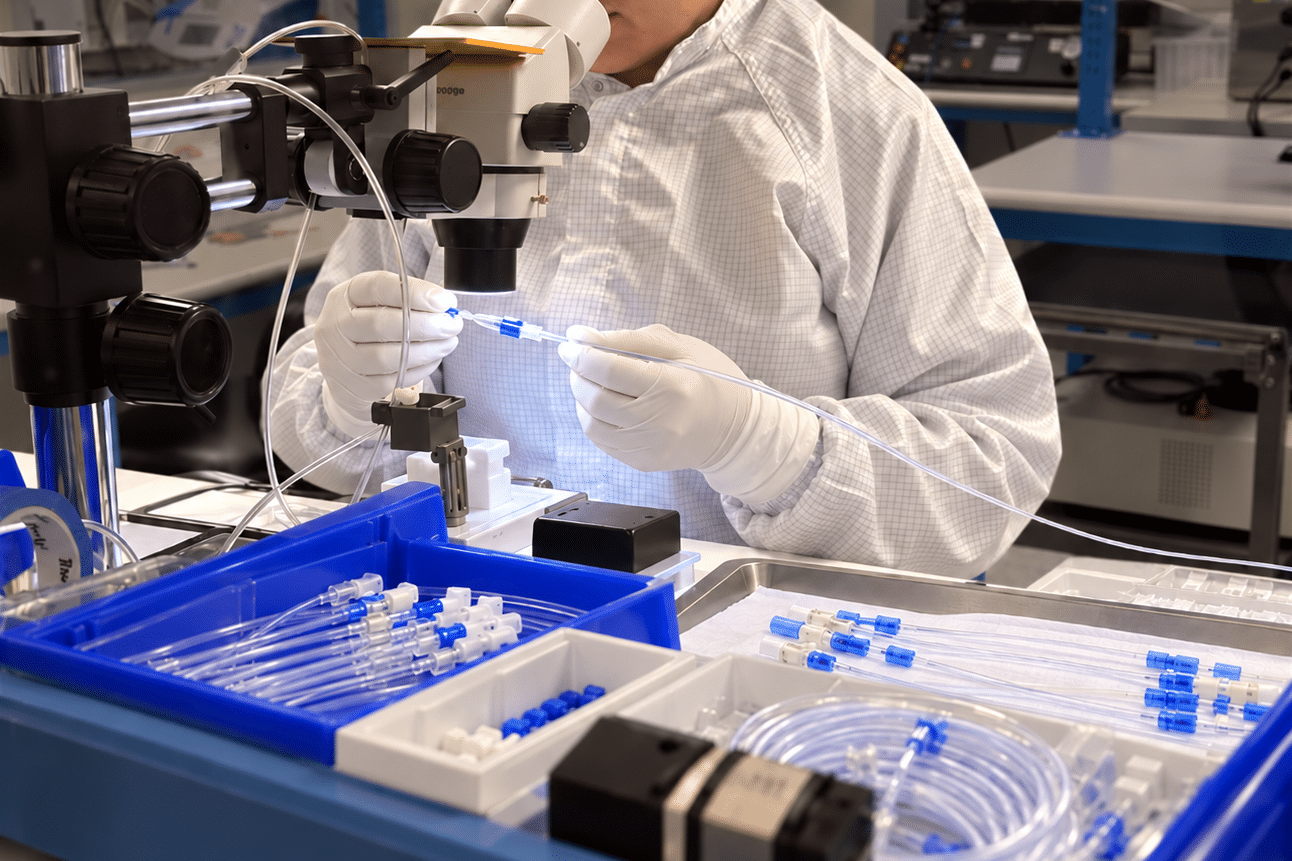
For devices requiring controlled environments, the manufacturing partner may also need appropriate cleanroom infrastructure. Pathway, for example, publicly describes ISO Class 7 cleanroom manufacturing for design verification, clinical builds, process development, and early commercial production, integrated with engineering, quality, and regulatory support.
The important characteristic is not simply the presence of a cleanroom, a molding machine, or an assembly bench.
It is the ability to connect engineering, manufacturing, quality, and the next regulatory or commercial milestone.
How to Pivot After a Large CM Rejects Your Program
If a major contract manufacturer declines the project, immediately sending the same RFQ to ten more large manufacturers may not solve the underlying problem.
A better approach is to determine why the program is difficult to place and systematically close that gap.
1. Identify what the rejection is telling you
Was the problem volume? Forecast uncertainty? Incomplete documentation? Design maturity? Tooling? Too much engineering work? An immature supply chain? A process outside the manufacturer’s core capabilities?
Those are very different problems.
Understanding the actual reason helps distinguish a sourcing issue from a manufacturing-readiness issue.
2. Define the next milestone, not the final destination
An early-stage company does not necessarily need to build the manufacturing system required for 500,000 units when its immediate requirement is a 300-unit verification build.
Instead, define what the next build must accomplish.
That may be proving design requirements, supporting a clinical study, establishing a controlled assembly process, validating packaging, preparing for submission, or satisfying early commercial demand.
The manufacturing strategy can then be designed around that milestone.
3. Build stage-appropriate manufacturing controls
The goal is not to prematurely optimize every process for full-scale automation.
It is to create enough control to manufacture the current device configuration appropriately and generate the evidence required for the next phase.
This may involve formalizing work instructions, defining inspection points, developing fixtures, qualifying suppliers, establishing traceability, refining test methods, or improving the design for manufacturability.
4. Use early production to remove uncertainty
Every controlled build should make the next build easier.
Manufacturing data should help determine where variation occurs, which steps consume unnecessary labor, where defects originate, which supplier issues recur, and what elements of the process need additional control.
This turns low-volume manufacturing into a commercialization tool rather than simply an expensive way to obtain a small quantity of product.
5. Prepare for eventual transfer
If the commercial forecast ultimately grows beyond the ideal range of the development-stage manufacturer, that is a good problem.
The manufacturing system should be built with that possibility in mind.
Released drawings, qualified suppliers, process documentation, inspection methods, tooling information, validation records, quality requirements, and manufacturing history all make a later transfer easier.
The objective is not to remain with an early-stage manufacturer forever.
The objective is to arrive at the next manufacturer ready.
Build the Supply Chain for the Stage You Are In
Scaling too early does not only create manufacturing problems. It can create supply chain problems as well.
Early-stage teams sometimes attempt to negotiate high-volume economics before their product configuration or demand forecast is stable. That can result in unnecessary tooling commitments, excess inventory, large component minimums, or suppliers that are poorly suited to frequent engineering changes.
At the opposite extreme, relying indefinitely on prototype suppliers can become equally problematic. Components may be expensive, lead times inconsistent, documentation limited, or processes poorly suited to controlled production.
The supply chain therefore needs to mature alongside the device.
At first, flexibility and engineering responsiveness may matter more than absolute piece price. As the design stabilizes, supplier qualification, cost structure, capacity, lead time, secondary sourcing, tooling, and quality performance become increasingly important.
Pathway’s public supply chain capabilities reflect this progression, combining DFM, supplier identification and qualification, sourcing, and planning for eventual production scale.
This prevents a common commercialization mistake: building a supply chain for the volume a company hopes to reach before the product is mature enough to support it.
Where Pathway Fits Between Prototype and Scale
Pathway MedTech operates in the portion of the product lifecycle where engineering decisions, manufacturing reality, quality requirements, and commercialization strategy begin to converge.
Based on Pathway’s public capabilities, that can include product development, Design for Manufacturability, supply chain development, quality and regulatory support, design verification manufacturing, controlled assembly, ISO Class 7 cleanroom manufacturing, packaging and sterile barrier support, process development, and production-transfer readiness.
That model is particularly relevant for companies that have outgrown informal prototype manufacturing but are not yet an ideal fit for a large production-focused CM.
The objective is not to compete with large-scale manufacturing indefinitely.
In many programs, Pathway can serve as the bridge that helps make a future large-CM relationship possible.
A device can move through engineering refinement, verification builds, process development, supplier qualification, early manufacturing, validation activities, and initial commercialization while the manufacturing package becomes increasingly mature.
When production volume eventually justifies a larger manufacturing platform, the company is in a much stronger position to transfer.
Instead of approaching a Tier-1 manufacturer with a device that still requires significant development interpretation, the company can approach with a more stable design, qualified supply chain, defined manufacturing processes, controlled documentation, production history, validation evidence, and a clearer commercial forecast.
That is a very different conversation.
Common Questions About Early-Stage Contract Manufacturing
Is there a standard medical device contract manufacturer minimum order quantity?
No. Minimum order quantities and program thresholds vary significantly between manufacturers.
A CM may evaluate annual revenue potential, forecasted production volume, manufacturing complexity, required equipment, engineering workload, cleanroom requirements, validation needs, materials, and long-term strategic fit.
Rather than asking only, “What is your MOQ?” early-stage companies should ask what type of program the manufacturer is operationally designed to support.
Why would a CM reject my medical device startup?
The rejection may have little to do with the startup itself.
The manufacturer may simply require higher volumes, greater design maturity, a more complete transfer package, established suppliers, or less ongoing engineering involvement than the program can currently provide.
The important question is what must change before the program becomes a fit.
When should an early-stage company approach a larger CM?
Usually when the characteristics that make large-scale manufacturing efficient are becoming more predictable.
That means the design is increasingly stable, manufacturing processes are defined, suppliers are established, quality requirements are understood, documentation is controlled, and commercial forecasts can reasonably support the manufacturer’s production model.
The transition does not need to occur at one universal unit volume.
Manufacturing maturity matters as much as volume.
A CM Rejection Can Be a Useful Signal
Getting rejected by a large medical device contract manufacturer can be frustrating, especially when a company has funding, a working prototype, and a legitimate need for product.
But it can also reveal something important.
The device may simply be in the wrong manufacturing environment for its current stage.
Trying to force a developing program into a production system built for mature products can create unnecessary cost, rigidity, delays, and frustration for both sides.
The better question is not:
“How do we convince a large CM to take us?”
It is:
“What manufacturing system does our device need right now, and what needs to mature before we scale?”
For many medical device companies, the path to large-scale manufacturing includes an intermediate stage where engineering, quality, supply chain, process development, verification, packaging, and controlled manufacturing need to work together.
That stage should not be treated as an inconvenience on the way to production.
It is where production capability is actually created.
Handled correctly, the result is not merely a successful 100-unit or 1,000-unit build. It is a device program that becomes easier to manufacture, easier to transfer, easier to scale, and better prepared for commercialization.
- U.S. Food and Drug Administration, Quality Management System Regulation (QMSR). The FDA’s current overview of the QMSR, including its February 2, 2026 effective date and incorporation by reference of ISO 13485:2016.
Review FDA QMSR Guidance - U.S. Food and Drug Administration, Quality and Compliance for Medical Devices. FDA information on current medical device quality and compliance requirements.
FDA Quality and Compliance - International Organization for Standardization, ISO 13485:2016. ISO’s overview of the internationally recognized quality management system standard for medical devices, including design, development, production, and regulatory requirements.
Review ISO 13485 Overview