TL;DR
TL;DR: Low‑volume medical device manufacturing is essential for design iteration, verification builds and early commercialization because it enables real‑world testing, compliance preparation and rapid refinement. High‑volume manufacturing drives down unit costs and meets global demand by standardizing processes and leveraging economies of scale. Successful programs bridge these stages by designing for manufacturability, maturing quality systems and understanding regulatory expectations. Accelerating too quickly to high volumes without sufficient design maturity can lead to non‑conformances, cost overruns and schedule slippages.
A robust quality management system aligned with ISO 13485 and the FDA’s Quality Management System Regulation (QMSR) is critical across all volumes. Pathway Medtech offers integrated support across development, manufacturing and quality to help device teams navigate each stage.
Setting the Context: Why Manufacturing Volume Matters
Bringing a medical device from concept to market rarely follows a straight line. Early in the journey, engineering teams iterate on prototypes, evaluate materials and refine geometries. They need manufacturing input without the burden of full‑scale production. Low‑volume manufacturing fills this gap by providing an environment for building small batches using the final processes. These builds support design verification and validation, allowing teams to test the finished device under real‑world conditions and identify improvements before scaling. Without this phase, projects risk moving into expensive tooling or large‑scale production with immature designs, a common cause of delay and cost escalation.
By contrast, high‑volume manufacturing is geared towards meeting growing global demand and achieving cost efficiency. With standardized processes and automation, manufacturers can produce consistent devices at a lower unit cost. These efficiencies help recoup research and development investments, bring innovative technologies to broader markets and support consistent quality. However, stepping into high‑volume production too soon, especially when a design has only been built tens of times, can expose design weaknesses and result in non‑conformances or costly rework. Understanding when and how to transition between these modes is critical for both patient safety and business viability.
Low‑Volume Manufacturing: A Bridge Between Prototypes and Production
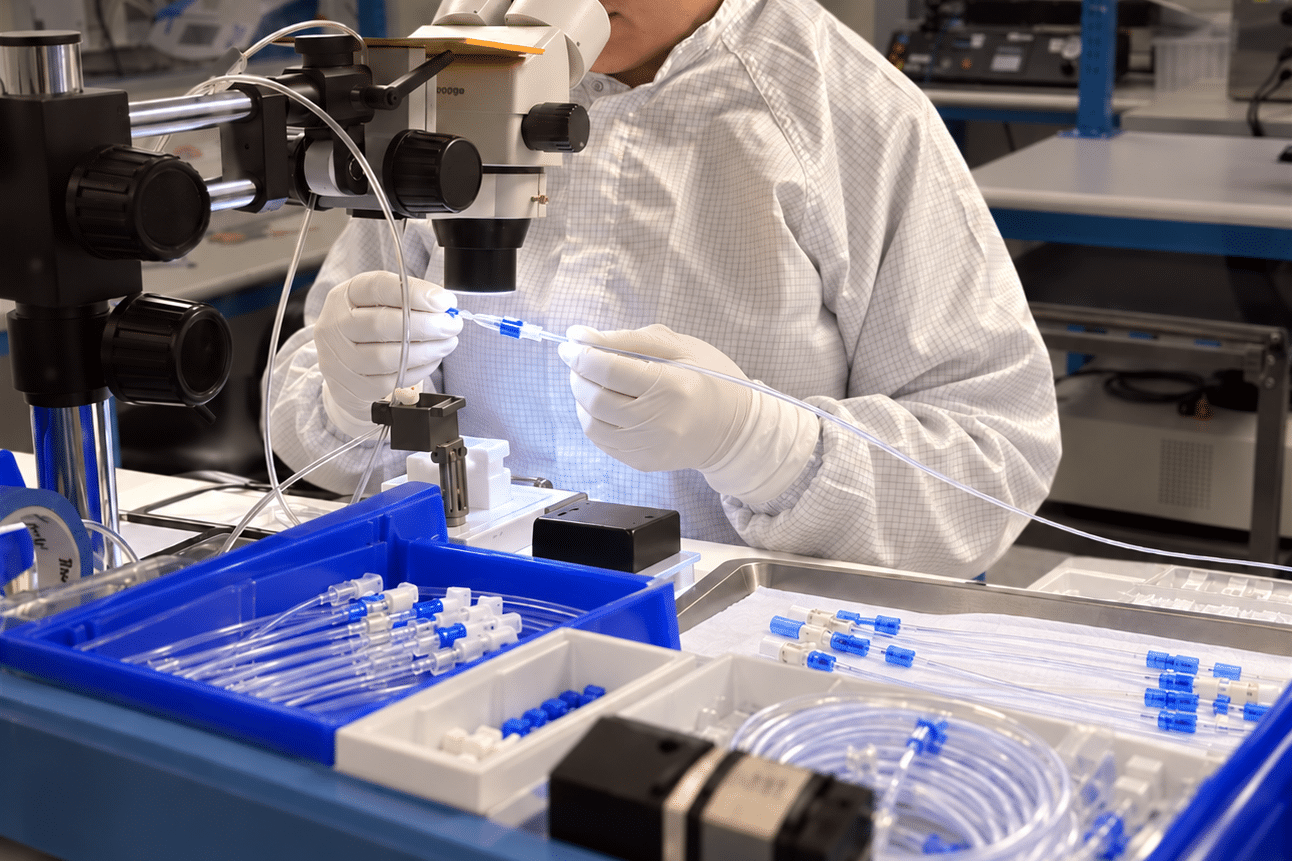
Low‑volume manufacturing, typically from a handful of units up to a few hundred, enables companies to produce devices using the same processes and materials intended for commercial runs. This stage supports thorough testing and validation under realistic conditions. Unlike prototype fabrication, low‑volume builds use production‑grade materials, controlled assembly processes and cleanroom environments. Running small batches helps reveal design tolerances, material behaviors and assembly challenges that do not surface during benchtop builds. It also generates the data required for verification and validation reports submitted to regulators. The FDA’s regulations require testing finished devices during V&V, making low‑volume production a regulatory necessity.
Another advantage of low‑volume manufacturing is cost control. While per‑unit costs are higher than in mass production, the overall investment remains manageable. Teams can iterate on design changes without scrapping thousands of components, and they avoid the capital expense of full tooling until the design is mature. This flexibility accelerates speed to market by enabling rapid refinements and early market feedback. It also aligns with the growing use of high‑mix/low‑volume (HMLV) manufacturing strategies in medtech, where devices are customized and volumes are modest. HMLV environments must remain flexible to accommodate evolving customer needs and frequent adjustments.
Pathway Medtech was founded to support this exact phase. Our low‑volume manufacturing environment integrates development, manufacturing and quality systems so that design teams receive production‑level feedback without leaving the quality framework. We help engineers refine geometries, evaluate materials and prepare documentation that aligns with ISO 13485 quality management requirements. Our specialized processes, ranging from injection molding and catheter hub assembly to medical cable harnesses, are tailored for short runs and evolving designs. By building within an ISO‑13485 registered facility, we ensure traceability and process control from the start.
High‑Volume Manufacturing: Efficiency, Standardization and Market Reach
High‑volume manufacturing comes into play when a design has been validated, market demand is clear and the business model supports scale. Producing large quantities of identical devices allows companies to meet global demand and maintain product availability. Economies of scale reduce per‑unit costs, enabling competitive pricing for healthcare providers and patients. Automation further enhances efficiency by reducing labour, minimizing human error and supporting continuous operation. As a result, manufacturers can recoup R&D investments more quickly and deliver advanced technologies to a wider patient base.
Standardization is another hallmark of high‑volume production. Well‑defined processes, validated tooling and repeatable assembly steps ensure that each unit meets strict specifications. Consistency is critical: a device’s performance directly affects patient outcomes. Data collected from high‑volume manufacturing can reveal trends and allow proactive corrections, strengthening product reliability. However, achieving this level of control requires significant upfront investment in equipment, tooling and process validation. Devices must be ready for scale before transferring to large contract manufacturers; otherwise, design immaturity can lead to quality issues and increased cost of goods.
Pathway Medtech offers contract manufacturing services that extend from short‑run assembly through large‑volume production. Our ISO‑13485‑certified facility houses class 7 cleanrooms, CNC machining, laser cutting and a range of molding and assembly technologies. We maintain compliance with the FDA’s 21 CFR part 820 (now the Quality Management System Regulation) and manage process validation, sterilization cycles and documentation to support regulatory submissions. Whether you need high‑precision assemblies in small batches or a scalable manufacturing partner with ongoing cost‑reduction support, our team can adapt to your needs without compromising quality or timelines.
Navigating the Transition: Design Readiness and Pitfalls to Avoid
Transitioning from low‑ to high‑volume manufacturing is not simply a matter of ordering more parts. Many start‑ups underestimate the complexity of scaling and overestimate how quickly they will need tens of thousands of units. Ramping up too early can expose latent design issues, resulting in non‑conformances, schedule slippages and increased cost of goods. A slow, controlled ramp allows teams to implement design for manufacturability (DFM) improvements, refine processes and build the documentation required for regulatory submissions.
Clinical manufacturing differs from commercial production. During early clinical trials, devices may be hand‑assembled using prototype methods. The objective is to demonstrate efficacy and safety, not necessarily achieve commercial cost targets. After trials, scaling to commercial volumes requires reducing variation so that the 100th unit performs like the first. Each step up in batch size introduces new sensitivities, material tolerances, assembly sequences and supplier variability, that must be understood and controlled.
A structured production readiness assessment helps identify gaps before scaling. Pathway’s production readiness and gap analysis services evaluate manufacturing procedures, tooling, documentation and quality checkpoints. We work with your team to develop fixtures, refine assembly workflows and create controlled processes that support repeatability at scale. By closing gaps early, device companies avoid delays and reduce risk during transfer to high‑volume manufacturing.
Regulatory and Quality Imperatives Across All Volumes
Whether producing ten devices or ten thousand, medical device manufacturers must operate within a rigorous quality framework. ISO 13485 defines the requirements for a quality management system tailored to the medical device industry. It covers the entire device lifecycle, design, development, production, installation and servicing, and ensures that devices are consistently safe and effective. Implementing an ISO 13485‑compliant system promotes continuous improvement, risk management and documentation, giving regulators and customers confidence in a manufacturer’s ability to meet requirements.
In February 2026, the FDA amended 21 CFR part 820 to harmonize with ISO 13485, renaming it the Quality Management System Regulation (QMSR). The rule incorporates ISO 13485 by reference and clarifies additional expectations to avoid inconsistencies. The FDA notes that ISO 13485’s requirements are substantially similar to the previous Quality System Regulation and provide a comparable level of assurance in a firm’s ability to consistently manufacture safe, effective devices. Manufacturers must therefore align their systems not only with international standards but also with the QMSR’s specific provisions for risk management, documentation and process control.
Operating under a compliant quality system benefits both low‑ and high‑volume programs. In early stages, it ensures that documentation and traceability are established from the outset; later, it supports efficient inspections, facilitates market access in multiple jurisdictions and reduces the risk of recalls. Pathway Medtech maintains an audited, cloud‑based quality system aligned with ISO 13485 and the QMSR. Our regulatory team assists clients in defining regulatory strategies, preparing submissions and managing ongoing compliance. By integrating quality and regulatory considerations with design and manufacturing, we help device companies streamline their path to market.
How Pathway Medtech Helps You Navigate Volume Transitions
Pathway Medtech was created to bridge the gap between prototypes and large‑scale commercialization. Our holistic approach connects development, manufacturing and quality systems under one roof. During low‑volume manufacturing, we collaborate with engineering teams to optimize design, choose materials and establish production processes that meet regulatory expectations. We support device verification builds and early commercialization runs in ISO‑13485‑registered cleanrooms, providing flexibility without sacrificing control.
When your device is ready to scale, our contract manufacturing capabilities, including CNC machining, precision molding, automated assembly and validated sterilization, enable seamless transition to high‑volume production. We maintain the same quality framework across volumes, ensuring that lessons learned during early builds inform large‑scale operations. Our production readiness assessments and gap analyses help teams identify and resolve challenges before they become costly roadblocks. And our regulatory experts assist with submissions, risk management and compliance, so you can focus on delivering innovative devices to patients.
If you are navigating the complexities of medtech manufacturing, we invite you to leverage our integrated services. Whether you need a handful of validation units or a trusted partner for full‑scale production, Pathway Medtech provides the expertise and infrastructure to move your product forward.
Building a Path from Innovation to Impact
Low‑volume and high‑volume manufacturing are not opposing choices but sequential stages on the journey from concept to market. Low‑volume builds provide the test bed for validating designs, refining manufacturing processes and generating the data required for regulatory submissions. High‑volume production delivers the scale, consistency and cost efficiency needed to meet market demand and improve patient access to technology. The transition between them demands careful planning, design readiness and robust quality systems. By aligning development, manufacturing and regulatory strategies early, device companies can avoid common pitfalls, reduce risk and accelerate commercialization.
Pathway Medtech exists to guide innovators through this journey. Our integrated services support every stage, from concept development and low‑volume manufacturing to high‑volume production and quality assurance. With ISO‑13485‑registered facilities, experienced engineers and regulatory specialists, we help medtech companies transform ideas into safe, effective devices ready for the world.
References
- Bioana, “The Importance of Low‑Volume Manufacturing in Medical Devices,” February 28 2024.
- ESSERT, “Medical device assembly – 7 crucial considerations,” 2025.
- New Concept Technology, “The Role of High‑Volume Product Development in the Medical Devices Industry,” 2025.
- PSC Software, “ISO 13485: The Essential QMS for Medical Device Quality,” 2024.
- U.S. FDA, “Quality Management System Regulation – Frequently Asked Questions,” updated February 2 2026.
- StarFish Medical, “Common Pitfalls When Ramping NPI Medical Device Manufacturing to High Volume,” 2024.