TL;DR
Bringing a medical device from prototype to market is rarely stalled by a lack of clinical innovation. Instead, programs hit friction when moving from laboratory feasibility to regulated manufacturing execution. Beyond being turned away by large contract manufacturers, early-stage companies, venture-backed startups, and clinician-innovators routinely suffer from fragmented vendor management, engineering team burnout from manual assembly, incomplete design transfer documentation, and unrepeatable “heroics-based” production. Partnering with an integrated, single-source partner provides immediate access to ISO 13485-certified cleanroom assembly while building and managing the complete upstream and downstream product ecosystem (specialized suppliers, testing labs, and sterilization partners). This unified execution model de-risks regulatory submissions, protects development capital, and bridges the gap between R&D and commercial scale.
Navigating the Hidden Bottlenecks of MedTech Growth
Bringing a novel medical device to market requires overcoming complex medical device commercialization pain points, from fragmented supplier management to manual assembly bottlenecks. In the early stages of a project, success is measured by technical proof of concept, bench testing, and validating clinical intent. Engineers and clinician-innovators spend months or years perfecting a device design to ensure it solves a genuine clinical need. However, demonstrating feasibility on an R&D workbench differs fundamentally from producing a commercial device consistently under strict federal regulatory oversight.
When a medical device program approaches clinical trials or regulatory submission milestones, informal assembly workarounds and flexible lab builds must be replaced by controlled, repeatable manufacturing processes. Many medtech executives and founders assume that finding a manufacturing partner simply means picking a contract manufacturer. When large contract manufacturers reject their program due to developing production volumes or evolving designs, leaders often assume their product is the problem. In reality, contract manufacturer rejection is only one surface symptom of deeper operational friction that threatens early-stage medical device programs.
1. When Engineers Become the Assembly Line
One of the most common signals that a medtech company has reached an operational impasse is when highly specialized R&D engineers spend their workweeks assembling devices by hand. In early feasibility phases, having design engineers assemble prototypes is essential for learning and design iteration. However, as build quantities increase to support preclinical studies, human factors testing, or Device Verification builds, manual assembly by engineering staff becomes a costly drain on company resources.
When senior engineers spend their time managing component inventories, chasing sub-tier vendors, assembling units at lab benches, and manually filling out build logs, core development stalls. Design refinements, Design for Manufacturability optimizations, and strategic regulatory activities fall behind. Transitioning assembly operations to a regulated manufacturing environment with trained assembly technicians and documented work instructions frees internal engineering teams to focus on advancing the product lifecycle.
2. Building the Product Ecosystem: Upstream Infrastructure Beyond Internal Walls
A major misconception in medical device development is assuming that a contract manufacturer only handles what happens inside its physical facility. A commercial medical device requires a complex, multi-tiered infrastructure spanning specialized component fabricators, resin suppliers, biocompatibility testing laboratories, sterile barrier packaging vendors, ethylene oxide sterilization facilities, and logistics partners.
When an emerging medtech firm tries to construct this upstream and downstream channel independently, they end up managing 6 to 10 disconnected vendors. Miscommunications between an offsite testing lab and a packaging vendor can delay regulatory filings by months.
Pathway Medtech addresses this by building and managing a customized product ecosystem for each client. For capabilities that extend beyond Pathway’s direct cleanroom floor, Pathway acts as the central engineering and quality orchestrator. Pathway selects, audits, qualifies, and manages the entire supplier network under an audited Quality Management System. This gives clients a complete, end-to-end operational infrastructure through a single accountable partner.
d.
3. Resolving Critical Medical Device Commercialization Pain Points
A device that can only be assembled by its original inventor is not a commercial product; it is an R&D project. Many emerging medtech programs rely heavily on tribal knowledge, specialized manual tweaks, or custom assembly workarounds that are never formally documented.
Under FDA Title 21 CFR Part 820.30(h) and the FDA Quality Management System Regulation, which aligns FDA requirements with ISO 13485:2016, formal design transfer is mandatory. Design transfer requires translating engineering drawings and user needs into a complete Device Master Record. This includes finalized bills of materials, raw material specifications, component inspection criteria, validated assembly fixtures, and step-by-step work instructions. Conducting a structured Production Readiness & Gap Analysis Audit identifies documentation gaps and fixture requirements early, converting “lab heroics” into an audit-ready, repeatable manufacturing process.
4. Bridging the Gap for Clinician-Innovators
Surgeons, physicians, and clinical researchers frequently identify profound procedural challenges in the operating room and design elegant technical solutions. However, clinician-innovators often face a steep learning curve when navigating FDA design controls, ISO 14971 risk management, cleanroom requirements, and verification protocols.
Without an experienced medtech partner, clinicians risk spending significant personal or seed capital on R&D prototypes that cannot be cleared by the FDA or manufactured efficiently. An engineering-led execution partner acts as a “medical device company in a box,” translating clinical insight into structured design inputs, formal prototypes, Device History Files, and submission-ready verification units. This integrated support allows clinician-founders to preserve their original clinical vision while building genuine enterprise value.
5. De-Risking Execution Before Commercial Scale
Transitioning a medical device from prototype to commercial launch does not require building an expensive internal factory or signing rigid, high-volume production commitments with massive contract manufacturers. The most capital-efficient path to market is right-sized execution: establishing controlled manufacturing for low-to-developing production volumes, such as clinical trial units, validation lots, and pilot commercial distribution.
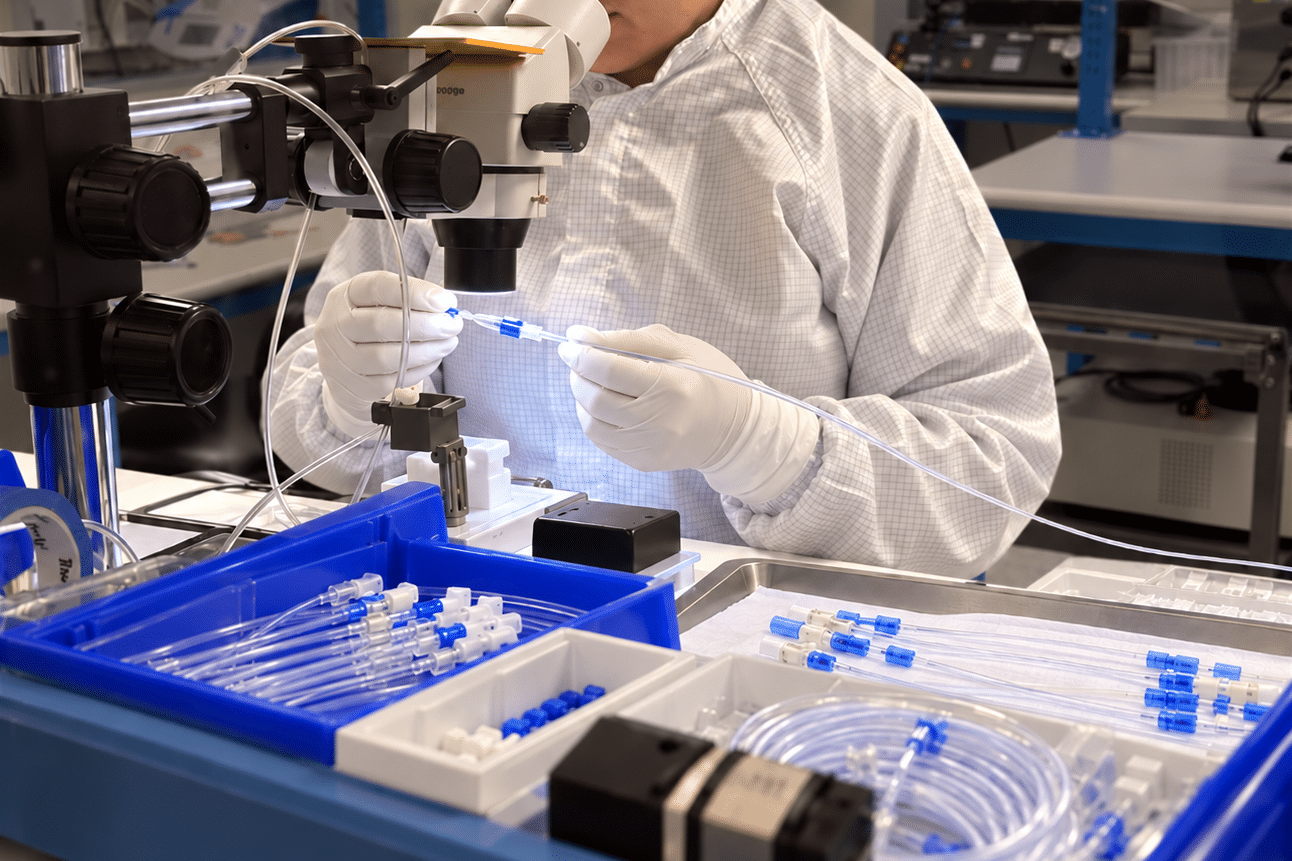
Pathway Medtech operates as an engineering-led development and contract manufacturing partner in Santee (San Diego), California. Operating within FDA-registered facilities equipped with in-house ISO Class 7 and ISO Class 8 cleanrooms, cloud-based QMS infrastructure, and custom assembly tooling, Pathway provides the exact regulatory foundation required for commercial success. By serving as a flexible “bridge to scale,” Pathway stabilizes manufacturing processes, qualifies supply chains, and establishes complete transfer packages, ensuring that medical device innovators scale with confidence.
Regulatory & Industry References
- U.S. Food and Drug Administration (FDA): Title 21 CFR Part 820, Quality System Regulation & Quality Management System Regulation. Available at: https://www.ecfr.gov/current/title-21/part-820
- International Organization for Standardization (ISO): ISO 13485:2016, Medical devices: Quality management systems, Requirements for regulatory purposes. Available at: https://www.iso.org/standard/59752.html
- International Organization for Standardization (ISO): ISO 14971:2019, Medical devices: Application of risk management to medical devices. Available at: https://www.iso.org/standard/72704.html
- U.S. Food and Drug Administration (FDA): Design Control Guidance for Medical Device Manufacturers. Available at: https://www.fda.gov/regulatory-information/search-fda-guidance-documents/design-control-guidance-medical-device-manufacturers