


TLDR
Outsourcing catheter assembly requires more than finding a manufacturer with the right equipment and requesting a per-unit price. Catheter OEMs should establish clear design specifications, material requirements, assembly processes, quality expectations, validation needs, and anticipated production volumes before seeking a manufacturing proposal. Providing this information early helps contract manufacturers identify technical risks, develop realistic quotations, and establish a more predictable path from design verification to commercial manufacturing. For emerging medical device companies, selecting a manufacturing partner capable of supporting engineering, controlled assembly, and production scale-up can be as important as the initial manufacturing cost.
Why Catheter Manufacturing Requires More Than an Assembly Partner
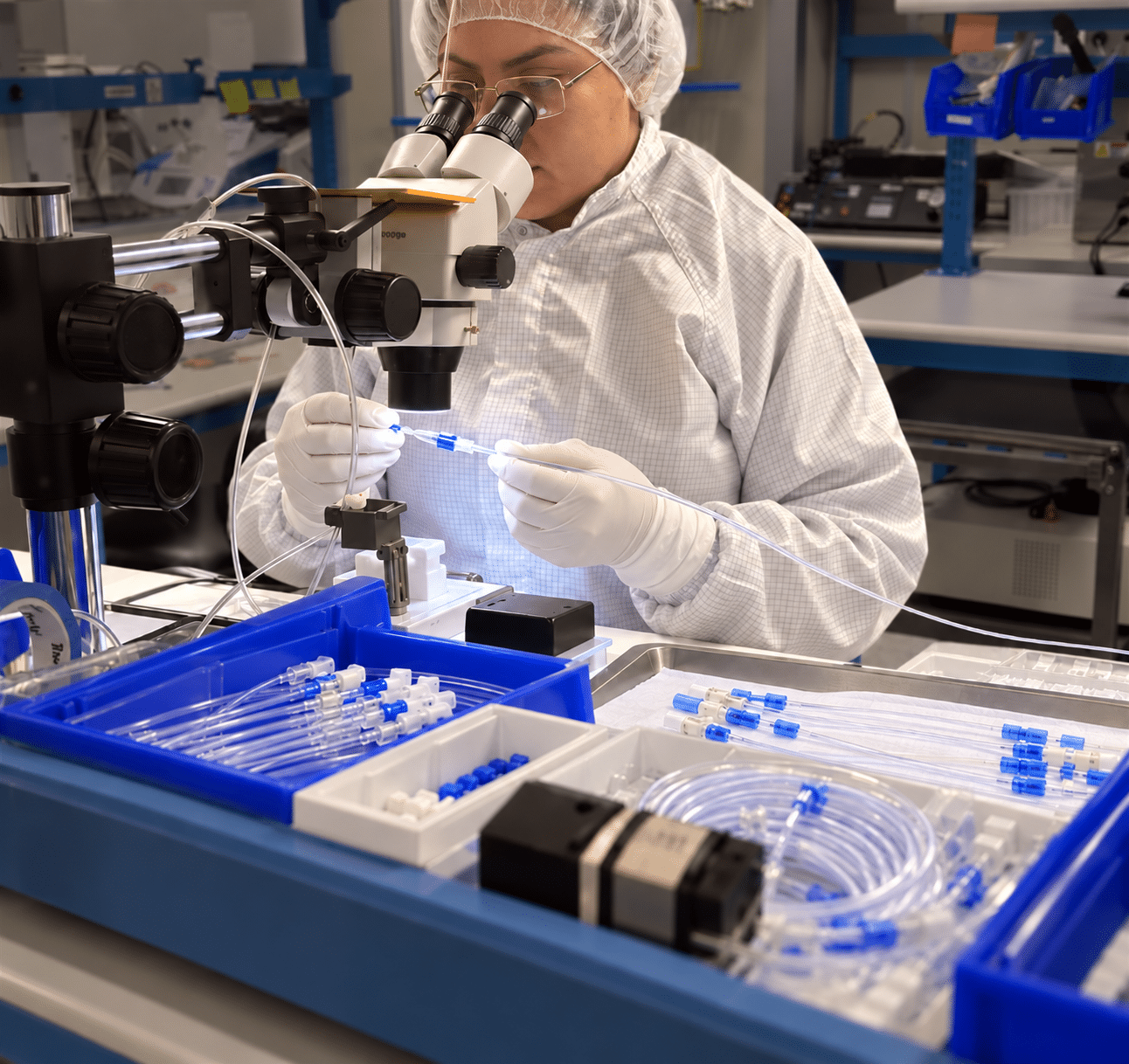
For medical device OEMs developing catheter-based technologies, transitioning from a functional prototype to repeatable manufacturing represents a significant technical and operational milestone. A catheter that performs successfully during development may still require substantial engineering, process development, and quality planning before it can be manufactured consistently. While the device itself may appear relatively straightforward, catheter systems often contain precision components, multiple materials, specialized joining methods, and performance characteristics that make manufacturing more complex than conventional assembly.
A typical catheter assembly may incorporate polymer tubing, reinforcement materials, molded connectors, metallic components, bonded joints, and functional features designed to support navigation, fluid delivery, aspiration, or another clinical application. Each element must perform as intended, but the manufacturing processes connecting those elements are equally important. Dimensional variation, inconsistent bonding, material incompatibility, or improper handling can affect device performance and manufacturing yield. The complexity increases when the process must be transferred from a development engineer assembling individual prototypes to trained production personnel operating within a controlled manufacturing environment.
This is why successful catheter outsourcing begins before a manufacturer receives a purchase order. The OEM and contract manufacturer need a shared understanding of the product’s design maturity, intended performance, critical characteristics, manufacturing constraints, and expected production requirements. Without that foundation, even a competitive quotation may fail to capture the actual work necessary to establish a dependable manufacturing process.
Pathway MedTech supports medical device companies through engineering, design verification manufacturing, controlled assembly, quality activities, and production development. By evaluating manufacturability alongside the device’s technical requirements, companies can begin identifying potential manufacturing challenges before they become expensive obstacles during verification or commercialization.
Establishing Complete Design Specifications Before Requesting a Quote
One of the most common challenges in catheter manufacturing outsourcing is requesting a production quotation before the design has been defined sufficiently for a manufacturer to evaluate it. A preliminary CAD model or functioning prototype can provide useful information, but it rarely communicates every manufacturing requirement. Critical dimensions, tolerance ranges, material specifications, assembly interfaces, performance acceptance criteria, and process-sensitive design characteristics may still need clarification. If these details remain uncertain, manufacturers must either make assumptions or include additional development activities in their proposals.
For catheter systems, specifications may include shaft dimensions, tubing wall thickness, lumen configuration, material composition, connector interfaces, bond geometry, and required mechanical performance. Depending on the application, relevant characteristics might include tensile strength, kink resistance, burst pressure, leak integrity, torque response, or flexibility. These requirements should originate from the device’s intended function, risk management activities, and established design inputs rather than being selected solely because a manufacturing process can achieve them.
The distinction between nominal dimensions and acceptable manufacturing tolerances is especially important. A catheter shaft with a specified outside diameter may appear simple to manufacture, but maintaining dimensional consistency across purchased tubing, bonded regions, and finished assemblies can require different controls. Overly restrictive tolerances may increase inspection effort or component costs without improving device performance, while excessively broad tolerances can introduce unacceptable variation. A design for manufacturability review helps evaluate whether proposed specifications are technically justified, measurable, and achievable through the selected manufacturing processes.
The OEM should also identify which design characteristics are finalized and which remain under development. A manufacturer quoting a stable design will evaluate a different scope of work than one supporting unresolved material selection, geometry changes, or assembly development. Communicating these uncertainties directly provides a stronger foundation for estimating engineering hours, tooling requirements, development builds, and recurring production costs.
Materials, Components, and Supplier Requirements Can Change the Manufacturing Strategy
Catheter manufacturing depends heavily on the characteristics and consistency of the materials entering the production process. Common polymer choices may include Pebax, polyurethane, nylon, PTFE, or other medical-grade materials, depending on the catheter’s intended function and performance requirements. Some devices also incorporate metallic reinforcement, specialty coatings, molded hubs, or other components sourced from multiple suppliers. Material selection affects much more than mechanical performance. It can influence bonding methods, processing temperatures, inspection strategies, sterilization compatibility, and the stability of the finished assembly.
For example, joining dissimilar polymers may require additional surface preparation, specialized adhesives, thermal processes, or alternative component designs. A bonding method that performs adequately during early prototyping may become difficult to control when component dimensions or incoming material characteristics vary. Similarly, changes in tubing formulation or supplier manufacturing methods can influence processing behavior even when the component appears dimensionally equivalent. These considerations make supplier controls and material documentation important elements of manufacturing readiness.
Before requesting a quotation, OEMs should identify approved material grades, preferred suppliers, applicable material specifications, and any restrictions on substitutions. Where available, the bill of materials should distinguish customer-supplied components from materials the manufacturer will source. It is also useful to identify long-lead or custom components, anticipated procurement quantities, and whether a supplier has already been evaluated for the intended application.
Supplier responsibilities should be established early because they affect both cost and project timing. If a contract manufacturer is expected to qualify new component sources, evaluate substitutes, manage purchased inventory, or coordinate specialty processing, those activities should appear within the proposed scope. Pathway’s development and manufacturing model includes supply chain and quality considerations, allowing the practical requirements of sourcing and production to be evaluated together rather than addressed only after assembly begins.
Defining Catheter Assembly Processes Before Production Begins
Once the product configuration and materials are understood, the next consideration is how the device will actually be manufactured. Catheter assembly may involve operations such as tubing preparation, component alignment, adhesive bonding, thermal joining, reflow, hub attachment, inspection, functional testing, and packaging. Not every catheter requires these processes, and the sequence depends on the device architecture. However, each operation can introduce variables that must be understood before the process is transferred into controlled production.
Consider a bonded catheter connector. The final joint may depend on adhesive selection, application volume, surface preparation, insertion depth, cure conditions, and material compatibility. If those variables are not adequately controlled, finished assemblies may exhibit inconsistent bond strength or leakage performance. A manufacturing process that relies on an experienced technician making visual or tactile adjustments may produce acceptable prototypes but become difficult to reproduce across multiple operators and production lots. Manufacturing engineering can address this by developing appropriate fixtures, standardizing work instructions, identifying process parameters, and establishing relevant inspection and testing methods.
It is equally important to determine which operations can be verified through inspection and which require process validation under the applicable quality management framework. Inspection may provide strong evidence of particular characteristics, but it cannot necessarily demonstrate every aspect of an internal bond, thermal joint, or process-sensitive feature. The strategy must reflect the specific device, associated risks, and whether subsequent verification can adequately establish the required output.
OEMs should ask prospective manufacturers how they approach process development, fixture design, operator training, in-process inspection, and management of manufacturing variation. These questions reveal considerably more about production readiness than a general statement that a supplier has catheter assembly experience.
Pathway supports engineering-led medical device manufacturing and design verification builds, enabling manufacturing processes to be evaluated and refined as programs move beyond prototype quantities.
Quality Systems and Documentation Should Be Defined Before Manufacturing Transfer
Selecting a catheter manufacturing partner also requires evaluating the systems used to control production and maintain objective evidence that devices meet specified requirements. In the United States, the FDA’s Quality Management System Regulation (QMSR), effective February 2, 2026, incorporates ISO 13485:2016 by reference within the revised 21 CFR Part 820 framework. The regulation establishes applicable quality management system requirements for medical device manufacturers within its scope. These requirements influence how organizations manage processes, supplier controls, production records, nonconforming products, risk-based decisions, and related manufacturing activities.
For an OEM outsourcing production, the responsibilities of each organization should be clearly defined. The contract manufacturer may execute assembly, inspection, testing, material control, and production documentation, while the OEM retains important responsibilities associated with the finished device and its regulatory requirements. A quality agreement can help describe these responsibilities, including expectations for change notification, product release, deviation handling, supplier management, and access to relevant manufacturing records.
Documentation is especially important during design verification and manufacturing transfer. Manufacturing instructions, equipment requirements, acceptance criteria, traceability expectations, training records, and process qualification activities must align with the approved device configuration. If engineering changes occur during the transition to manufacturing, they should be evaluated through appropriate change-control processes so that production documentation and affected verification activities remain consistent with the revised design.
A common mistake is selecting a manufacturer based on technical equipment alone while postponing discussions about quality responsibilities until production is underway. Although a supplier may have the physical capability to assemble a device, gaps in documentation, process controls, or defined responsibilities can complicate verification and future commercialization.
Pathway’s ISO 13485-certified manufacturing environment and quality and regulatory support provide a foundation for coordinating these requirements within a medical device manufacturing program.
Understanding Process Validation and Design Verification Requirements
Design verification and manufacturing process validation serve different purposes, and confusing the two can create significant planning problems. Design verification evaluates whether the device design meets its established design inputs. Manufacturing process validation, where required, provides evidence that a process can consistently produce outputs meeting predetermined specifications. A catheter assembly passing functional testing does not automatically establish that the manufacturing process is adequately characterized or controlled.
Consider a catheter shaft bonding operation. Verification testing may demonstrate that representative devices meet a defined tensile strength requirement. Manufacturing process validation may need to address the operating parameters, material conditions, equipment characteristics, and production practices influencing the consistency of that bond. Manufacturers frequently organize qualification activities using Installation Qualification (IQ), Operational Qualification (OQ), and Performance Qualification (PQ), although the precise approach depends on the process, regulatory requirements, and associated risk.
The sequencing of these activities can significantly affect program timelines. If process development is incomplete when formal qualification begins, testing may identify variation that requires further engineering work, modified equipment settings, additional samples, or revised manufacturing instructions. In turn, these changes can affect material requirements, build schedules, and the scope of subsequent testing. Establishing a realistic relationship between development builds, verification builds, qualification activities, and production readiness helps reduce these risks.
For OEMs requesting manufacturing quotations, it is important to identify whether the expected scope includes engineering prototypes, design verification units, clinical builds, validated production processes, or routine commercial manufacturing. These are different manufacturing objectives and should not be treated as interchangeable milestones.
Pathway supports regulated design verification manufacturing, including engineering optimization, supplier qualification, controlled execution, and documentation structured to support subsequent commercialization activities.
Manufacturing Volume, Tooling, and Automation Influence Quotation Accuracy
A manufacturer’s ability to quote catheter assembly accurately depends partly on the expected production quantity and the maturity of the production process. A program requiring several hundred design verification units may benefit from controlled manual operations and relatively simple fixtures. A commercial program involving thousands of units per month may require different equipment, staffing, supplier arrangements, and process controls. The most economical approach depends on the relationship between upfront investment and recurring manufacturing costs.
For example, a manually operated fixture may be appropriate during early builds because it offers flexibility while the design and assembly process are refined. As production volume increases, a more sophisticated fixture or semi-automated process may improve throughput and reduce operator-dependent variation. However, specialized equipment introduces its own engineering, installation, maintenance, and qualification requirements. Automating an unstable process can create additional complexity rather than solve the underlying manufacturing problem.
This is why volume forecasts should distinguish immediate build requirements from realistic future demand. A manufacturer quoting 300 verification devices will make different assumptions than one preparing for recurring production of 3,000 devices per month. OEMs should also communicate anticipated ramp schedules, demand variability, expected lot sizes, and whether the program is likely to undergo additional engineering changes.
When reviewing a proposal, the distinction between nonrecurring engineering expenses and recurring unit costs should be explicit. Tooling, fixtures, process development, equipment qualification, and engineering support may be quoted separately from routine production expenses. Comparing only the finished unit price can obscure meaningful differences between proposals.
Pathway’s manufacturing approach supports programs moving from development and controlled low-volume builds toward more mature production methods, allowing equipment and automation strategies to reflect the needs of the device rather than a predetermined production model.
Packaging, Sterilization, and Finished-Device Requirements Cannot Be an Afterthought
For sterile catheter products, a manufacturing quotation that stops at the assembled device may provide only a partial picture of the work required. Sterile barrier packaging, packaging process validation, sterilization coordination, shelf-life planning, labeling, and distribution testing can all influence the finished-device manufacturing strategy. These activities should be considered before production begins because the device configuration and materials may affect packaging selection and sterilization compatibility.
A long or delicate catheter assembly may require internal support, protective packaging features, or a tray configuration that limits movement during handling and distribution. Components susceptible to deformation, coating damage, or mechanical stress may create additional considerations. The packaging materials must also be suitable for the selected sterilization approach and intended storage conditions. For terminally sterilized devices, the ISO 11607 series provides an important framework for sterile barrier systems and packaging process validation.
Changes made late in the program can affect more than packaging material costs. Modifying the device geometry or package configuration may require additional packaging assessment, revised sealing parameters, or further testing. Similarly, selecting a sterilization method without adequately evaluating material and functional compatibility can create problems that require design or process changes.
Pathway supports sterile barrier system development, cleanroom packaging, ISO 11607 packaging validation, aging and distribution-related testing, and sterilization coordination. For catheter OEMs, evaluating these capabilities alongside assembly requirements can provide a more complete understanding of the work necessary to deliver a finished medical device.
What a Complete Catheter Manufacturing RFQ Should Communicate
A request for quotation, or RFQ, is most valuable when it allows potential manufacturing partners to assess the same technical requirements and commercial assumptions. An incomplete request may still initiate a useful discussion, but the resulting estimate can be heavily dependent on assumptions that differ from one supplier to another. Those differences make quotations difficult to compare and may create scope changes once development work begins.
A practical catheter manufacturing RFQ should communicate the device’s intended function, current design status, available drawings and specifications, bill of materials, expected assembly operations, required inspection and testing activities, and any identified critical characteristics. It should also describe which materials are customer-supplied, which components require supplier sourcing, and whether the manufacturer is expected to perform engineering development or process qualification. The expected production volume, timing, packaging requirements, sterilization strategy, and documentation needs should be included where they are known.
OEMs should not feel compelled to present unresolved development questions as finalized requirements. Identifying open technical issues often produces a more useful proposal because the manufacturer can distinguish engineering work from established production operations. A phased quotation may be appropriate, separating manufacturability review, process development, controlled pilot builds, and commercial manufacturing into defined stages with corresponding deliverables.
The goal is to create a common technical and commercial understanding before the manufacturing relationship begins. An effective RFQ is not simply a request for pricing. It is an opportunity to identify gaps in manufacturing readiness and determine whether a supplier has the experience, infrastructure, and flexibility required for the program.
Frequently Asked Questions About Outsourced Catheter Assembly
What should an OEM provide to a catheter contract manufacturer?
An OEM should provide available engineering drawings, material specifications, a bill of materials, device performance requirements, expected assembly processes, production volume estimates, and applicable quality, testing, packaging, and sterilization requirements. Unresolved design or manufacturing questions should be identified rather than concealed, allowing the manufacturer to propose an appropriate development and production scope.
Can a catheter manufacturer support design verification builds?
Yes, provided the manufacturer has suitable technical capabilities, quality systems, process controls, and documentation practices for the program. Design verification builds often require controlled manufacturing configurations and traceability that are more formal than those used during exploratory prototyping.
Does catheter assembly always require a cleanroom?
No. Cleanroom requirements depend on the device, its intended use, contamination risks, manufacturing processes, and applicable product requirements. Some catheter assembly operations may be performed in other appropriately controlled environments, while certain devices or operations require specified environmental controls. The appropriate manufacturing environment should be established through the product’s requirements and risk management activities.
Is an ISO 13485-certified contract manufacturer required?
The specific legal and contractual requirements depend on the device, jurisdiction, and manufacturer’s role. ISO 13485 certification can provide useful evidence about a supplier’s quality management system, but certification alone does not establish that a particular device, manufacturing process, or facility is suitable for the intended program. OEMs should assess the manufacturer’s actual capabilities and applicable regulatory responsibilities.
How long does catheter manufacturing transfer take?
The timeline varies according to design maturity, component availability, process complexity, tooling needs, qualification requirements, and the scope of verification or validation work. A stable design with established suppliers may require less development than a program involving unresolved bonding methods, custom equipment, or supplier changes. A realistic timeline should be developed after reviewing the device and its manufacturing requirements.
How can catheter OEMs reduce manufacturing costs?
Potential opportunities include improving design for manufacturability, simplifying assembly operations, optimizing component specifications, reducing process variation, improving yield, and introducing appropriate fixtures or automation when volumes justify the investment. Cost reductions should preserve the device’s established requirements and applicable quality controls.
Choosing a Catheter Manufacturing Partner That Supports the Next Stage
Outsourcing catheter assembly is ultimately a decision about manufacturing readiness, technical execution, and the ability to maintain product consistency as a program evolves. Equipment availability and unit pricing matter, but they represent only part of the evaluation. OEMs also need to consider engineering expertise, supplier controls, assembly process development, quality documentation, validation capabilities, packaging requirements, and the manufacturer’s ability to adapt as production needs change.
For emerging medical device companies, these considerations are especially important during the transition from prototypes into verification, clinical production, and early commercialization. Selecting a manufacturing partner capable of addressing unresolved technical requirements can reduce unnecessary handoffs and provide greater continuity between development and production. Pathway MedTech works across these stages, combining medical device engineering, controlled manufacturing, quality and regulatory support, packaging, and commercialization planning within its broader service offering.
A strong manufacturing partnership begins with clearly defined expectations. OEMs that invest time in preparing complete specifications, identifying manufacturing risks, and communicating realistic production requirements are better positioned to obtain meaningful quotations and establish a manufacturing process that supports both product quality and long-term commercial objectives.
References
- U.S. Food and Drug Administration. Quality Management System Regulation (QMSR). Overview of the FDA’s revised quality management requirements, effective February 2, 2026.
https://www.fda.gov/medical-devices/postmarket-requirements-devices/quality-management-system-regulation-qmsr - Electronic Code of Federal Regulations. 21 CFR Part 820, Quality Management System Regulation.
https://www.ecfr.gov/current/title-21/part-820 - International Organization for Standardization. ISO 13485:2016, Medical devices: Quality management systems, Requirements for regulatory purposes.
https://www.iso.org/standard/59752.html - International Organization for Standardization. ISO 14971:2019, Medical devices: Application of risk management to medical devices.
https://www.iso.org/standard/72704.html - International Organization for Standardization. ISO 11607, Packaging for terminally sterilized medical devices. Parts 1 and 2 address packaging-system requirements and packaging process validation, respectively.
https://www.iso.org/standards.html - U.S. Food and Drug Administration. Quality Management System Regulation: Frequently Asked Questions.
https://www.fda.gov/medical-devices/quality-management-system-regulation-qmsr/quality-management-system-regulation-frequently-asked-questions


